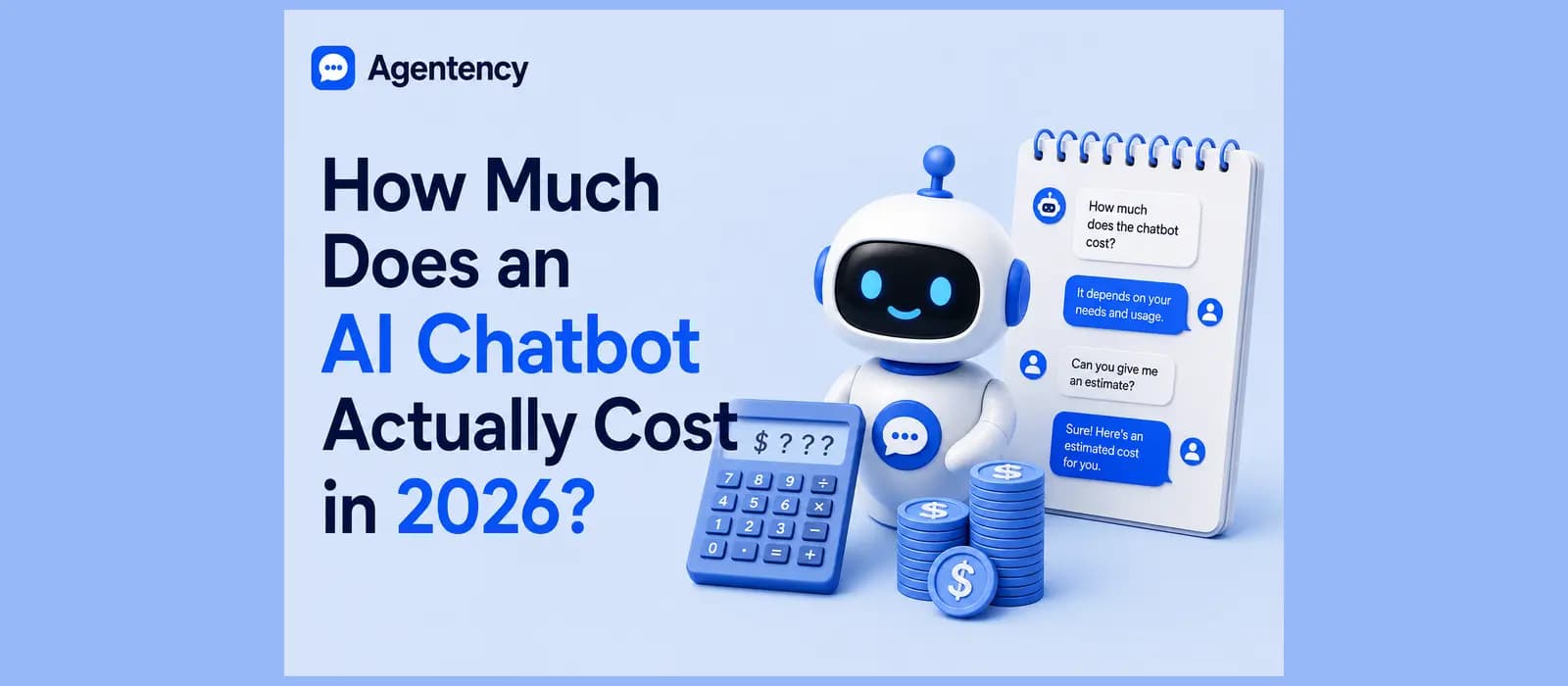
How Much Does an AI Chatbot Actually Cost in 2026?
What How Much Does a Chatbot Cost Actually Depends On
Someone asks "how much does a chatbot cost" and gets back answers ranging from nineteen dollars a month to three hundred fifty thousand dollars. Both answers are true. Neither one is useful on its own, because they're describing completely different products that happen to share a name.
A website widget that answers five FAQ questions and a custom built AI agent handling thousands of order status questions across WhatsApp are not the same purchase, even though a search for how much does a chatbot cost will hand you both in the same list of results. The actual number you'll pay depends on four things, and once you know which of the four applies to you, the range collapses fast. If you searched the slightly longer version, how much does it cost to develop a chatbot, you'll get the same mixed answer, because that phrase covers every one of the four paths below just as loosely.
The Four Things That Move the Number
How you buy it. A subscription platform, a per resolution fee, an agency build, or an in house team, each one prices the same outcome completely differently.
How many conversations you actually have. Most of the pricing models below charge by volume in one form or another, so your number matters more than the plan name.
Which channels you need covered. WhatsApp specifically adds a layer most website only tools don't have, since messages get billed separately from the platform fee.
Whether the fee stacks. Some platforms bundle everything into one number. Most bolt the AI on top of a seat price, then bolt a usage fee on top of that.
We'll go through each of these honestly, using real numbers from the platforms that actually publish them, and say plainly where the number on the pricing page and the number on your invoice tend to disagree.
Ready to see what a flat number actually looks like for your own volume? Create a free account and connect your own content in a few minutes.
The Real Pricing Models, Named Honestly
Ask five vendors about their chatbot pricing model and you'll get five different answers, but they all collapse into the same five buckets below. This is the actual chatbot pricing structure worth understanding before you compare a single number, and it's a better use of your time than reading one more generic ai chatbot pricing roundup that lists the same fifteen platforms without ever separating them into these five real categories.
Subscription and Flat Rate
You pay one number a month regardless of how many conversations the bot handles, up to a limit. Chatbase runs nineteen to a little under two hundred dollars a month with the AI included in that number rather than billed separately. Heeya runs free up to ninety nine dollars a month on the same basis. Agentkit runs free up to just under four hundred dollars a month across its message tiers. ChatMaxima runs a similar shape, nineteen to four hundred ninety nine dollars a month across four flat tiers with no free plan but a short trial instead. This is the simplest chatbot software pricing to budget against, and the one most small businesses actually want, because the number you see is the number you pay.
Agentency sits in this same category, flat per agent from free up to four hundred ninety nine dollars a month, which we'll come back to once you've seen what the other four models actually cost in practice.
Per Resolution
You pay a fee every time the AI successfully resolves a conversation, on top of a separate base or seat price. Intercom's Fin charges ninety nine cents per resolution with a fifty resolution monthly minimum, plus a seat fee that runs from around twenty nine to eighty five dollars depending on the plan. Zendesk charges one dollar fifty to two dollars per automated resolution on top of agent seats that run nineteen to over a hundred sixty dollars each. HubSpot's Breeze agent charges fifty cents per resolved conversation on top of its seat pricing.
The appeal is obvious. You only pay for results. The catch is just as obvious once you sit with it. A bot that gets better at its job costs you more money for getting better, which is a strange incentive to build a chatbot pricing model around.
WhatsApp and Messaging
If your customers are on WhatsApp, there's a second bill hiding behind the platform fee. Meta charges per message once you're outside the free twenty four hour customer service window, and the rate varies by country and message category. Several platforms add their own markup on top of that pass through cost, typically a few tenths of a cent per message, or a flat WhatsApp add on fee. The platform subscription is often the smaller of the two numbers here, and it's the one most pricing pages actually show you.
Agency Build
A one time build fee, then a separate ongoing maintenance contract. This is chatbot as a service pricing's opposite, you're paying for a build instead of renting access to one, and it's the honest answer when someone specifically asks how much does it cost to develop a chatbot with genuinely custom requirements rather than a standard use case. Real ranges across the sources we reviewed run from five thousand dollars for a simple rule based bot up to three hundred fifty thousand dollars or more for a fully custom, compliance heavy build. That upfront number is the chatbot development cost specifically, separate from what it costs to keep running afterward. Maintenance typically runs fifteen to twenty percent of the build cost every year, which means a fifty thousand dollar bot needs seven thousand five hundred to ten thousand dollars annually just to keep working as your products and policies change.
Curious what a build like this would actually need to solve before you commission one? See our honest comparison of Chatbase against Agentency for where a platform already covers the same ground.
DIY
You build it yourself on top of an LLM API. The API calls are genuinely cheap, a real worked example from Anthropic puts ten thousand support conversations at roughly thirty seven dollars total on Claude Haiku, often a few dollars for thousands of conversations once caching is factored in. What isn't cheap is everything around them. A conversational AI engineer runs roughly one hundred twenty thousand dollars a year in salary alone, and that's before hosting, a vector database that can climb from fifty dollars a month to several hundred as your data grows, and the maintenance of every channel connector and dashboard a platform would otherwise hand you already built.
The honest way to think about how much does a chatbot cost when you're building it yourself is that the token bill is almost never the number that breaks the budget. The people and the infrastructure around those tokens are.
What Everyone's Comparison Table Leaves Out
Every vendor in this space publishes a comparison table, and every one of those tables happens to make that vendor look best, usually by picking the specific volume and plan tier where its own model wins. Here's the same math done once, honestly, at a single common volume, two thousand resolved conversations a month, which is a realistic number for a growing small business.
Intercom Fin at two thousand resolutions runs about one thousand nine hundred eighty dollars in resolution fees alone, plus a seat fee that adds another thirty to two hundred fifty dollars depending on team size. Zendesk at the same volume runs three thousand to four thousand dollars in resolution fees before a single seat is counted. HubSpot's Breeze agent runs about one thousand dollars in resolution fees at that volume, on top of Professional or Enterprise seat pricing. Tidio's own published pricing bills its Lyro add on at fifty cents to a dollar per AI conversation, which lands between one thousand and two thousand dollars a month for the AI layer alone at that volume, separate from its base plan. ChatBot.com, the Text owned platform many people just call chatbot.com, charges nineteen to seventy nine dollars per seat plus ninety nine cents per AI resolution, which puts a small three seat team at roughly two thousand dollars a month at the same volume once the resolution fee is added in.
None of those numbers are hidden exactly. They're just never shown together, because the vendor showing you the table has every reason to pick the volume and the comparison that flatters its own model. Do the math yourself before you sign anything, using your actual expected volume, not the example on someone else's pricing page.
Curious how this looks against a flat number instead? See how Agentency compares to Intercom Fin at the same volume.
Questions Worth Asking Before You Pick a Plan
Ask for the total monthly cost at your actual expected volume, not the entry tier number on the pricing page, and make them write it down.
Ask exactly which fees stack on top of the headline chatbot price, seat, resolution, WhatsApp, add ons, and get the full list before you sign anything.
Ask whether your own testing counts against your monthly quota the same way a real customer conversation would.
Ask what the chatbot agency pricing actually includes if you're considering a custom build, specifically whether maintenance is bundled or billed separately once the bot ships.
Ask how much does it cost to develop a chatbot with the exact integrations you need, not a generic estimate, since a CRM connection alone can shift a quote by tens of thousands of dollars.
Ask directly whether the number you're being quoted answers how much does it cost to develop a chatbot from scratch, or whether it's actually a subscription with a setup fee dressed up to sound like a build.
Hidden Costs Nobody Puts on the Pricing Page
Maintenance
Fifteen to twenty percent of the original build cost, every year, for a custom bot. Nobody puts this on the same page as the build price, and it's the single biggest reason a "cheap" custom build stops looking cheap by year two.
Integrations
Connecting a bot to your CRM, your helpdesk, or your store typically adds twenty to fifty percent to a custom project's total cost, and each individual connection can run one thousand to twenty five thousand dollars depending on how messy the system on the other end is.
Human Handoff
No bot resolves everything. The share that escalates to a person, usually ten to twenty five percent of conversations even on a strong deployment, still needs a human agent on the other end, and that person's seat, salary, and training are a real cost that a chatbot budget conversation frequently forgets to include.
Overage and Testing
Several platforms count your own testing against your monthly quota the same way they'd count a real customer message, which quietly eats into the allowance you thought you had before a single real conversation happened. Ask directly whether testing counts against your limit before you pick a plan based on that limit.
How to Estimate Your Own Number
Every worked example in this guide uses two thousand monthly conversations because it's a realistic starting point for a growing business, but your actual how much does a chatbot cost answer depends on your own volume, not ours.
Count Your Real Monthly Conversations
Look at your current support inbox, WhatsApp thread, or contact form for a real month, not a guess. This is the single number that changes every calculation above more than any other input.
Pick the Model That Matches Your Risk Tolerance
If your volume is steady and predictable, a flat rate removes the guesswork entirely. If your volume swings wildly month to month, a per resolution model can genuinely cost less in a slow month, though it costs more the moment your bot starts working well.
Add the Costs Nobody Quotes First
Whatever number a vendor gives you, add maintenance if you're building custom, add a WhatsApp pass through fee if that's a channel you need, and add the seat cost for whoever handles the conversations the bot escalates.
Once you've done that math for two or three vendors using your own numbers, the how much does a chatbot cost question usually answers itself, and it's rarely the vendor with the lowest number on the homepage.
Where Agentency Fits
Flat Pricing, Not Stacked Fees
Every model in the comparison above, except the pure flat rate platforms, requires you to add at least two numbers together to know your real monthly cost. Agentency prices flat, per agent, from a free plan up to four hundred ninety nine dollars a month, with no per resolution fee, no seat charge, and no separate WhatsApp add on. The number on the pricing page is the number on the invoice. See the current tiers on the pricing page.
Reading Your Own Content, Not a Script You Wrote
Most of the per resolution platforms above ground their answers in a help center or a scripted flow you built yourself. Agentency connects to your store or your documents directly and answers from what you've actually published, with an anti hallucination retrieval step built in, rather than needing you to write and maintain a script for every question in advance. See how this works in our guide to training an AI agent on your own catalog.
WhatsApp Included, Not Billed Separately
WhatsApp is one of ten messaging channels Agentency deploys across, alongside a website widget and a hosted chat link, at no extra platform fee on top of your plan. Compare that against the seat plus resolution plus WhatsApp add on stack most of the platforms above actually charge. Our roundup of WhatsApp AI agent platforms covers this channel gap in more depth.
Setting Up Without a Sales Call
Several of the enterprise names above, Ada among them, route you through a sales conversation before you see a real number.
Create Your Account and Connect Your Content
Sign up free, then point Agentency at your store or your documents so it has something real to answer from before you write a single flow by hand.
See What It Already Handles
Test it against your own real questions before you compare a single paid tier anywhere else. If it covers what you need on the free plan, you've saved the cost of finding out the hard way.
Ready to see what your own volume would actually cost on a flat plan? Start free and connect your content in a few minutes.
Key Takeaways
How much does a chatbot cost depends on which of four buying paths you're actually comparing, subscription, per resolution, agency build, or DIY, and comparing prices across paths is comparing different products.
Per resolution pricing charges you more the better your bot performs, which is a strange incentive once you actually sit with it.
At two thousand monthly resolved conversations, Intercom Fin, Zendesk, and Tidio's Lyro add on all land somewhere between one thousand and four thousand dollars a month before seat fees, numbers that rarely appear side by side because each vendor's own table is built to flatter its own model.
Maintenance, integrations, and human handoff are the three costs that consistently don't make it onto the original pricing page, and together they're usually bigger than the number that did.
Flat, per agent pricing is the one model in this whole comparison where the number you see is the number you pay, which is the honest answer to how much does it cost to develop a chatbot without a calculator involved.
Frequently asked questions
How Much Does an AI Chatbot Cost?
It depends on the pricing model, which is really the whole point of this guide. Subscription platforms run free up to a few hundred dollars a month with everything included. Per resolution platforms add fifty cents to two dollars per resolved conversation on top of a seat fee. Custom builds start around five thousand dollars and can exceed three hundred fifty thousand. Agentency runs flat, from free up to four hundred ninety nine dollars a month, with nothing added on top.
How Much Does It Cost to Build a Chatbot?
A simple rule based bot runs roughly five thousand to fifteen thousand dollars to build. A mid complexity AI bot with real natural language understanding runs eight thousand to eighty thousand. An enterprise build with deep integrations and compliance requirements runs eighty thousand to three hundred fifty thousand or more. None of those figures include the fifteen to twenty percent annual maintenance a custom build needs afterward, which is its own separate chatbot development cost that rarely appears next to the build number.
How Much Does It Cost to Make a Chatbot?
If you mean building one yourself rather than hiring an agency, the API costs are genuinely small, often a few dollars for thousands of conversations on a model like Claude Haiku. The real cost is the engineering time around those API calls, hosting, a vector database, and the ongoing maintenance of every connector a ready made platform would otherwise hand you already built.
Does a Chatbot Cost Money?
Almost every platform has a free tier, and it's usually enough to test the concept on real content before you pay anything. The free tiers cap conversations, contacts, or AI resolutions, and most gate the AI features specifically behind a paid plan once you exceed a fairly small monthly limit. Agentency's free plan has no time limit and no card required, which makes it a reasonable first stop before you compare any chatbot software pricing at all.
How Much Does a Customer Service Chatbot Cost?
The same pricing models apply, subscription, per resolution, or custom build, but customer service specifically tends to push volume higher than a simple lead capture bot, since every existing customer with an order question becomes a conversation. That makes the per resolution trap worse for support use cases specifically, since resolution volume for support is usually the least predictable number in the whole budget.