Sales AI Agent: What It Is, How It Works & What It Costs
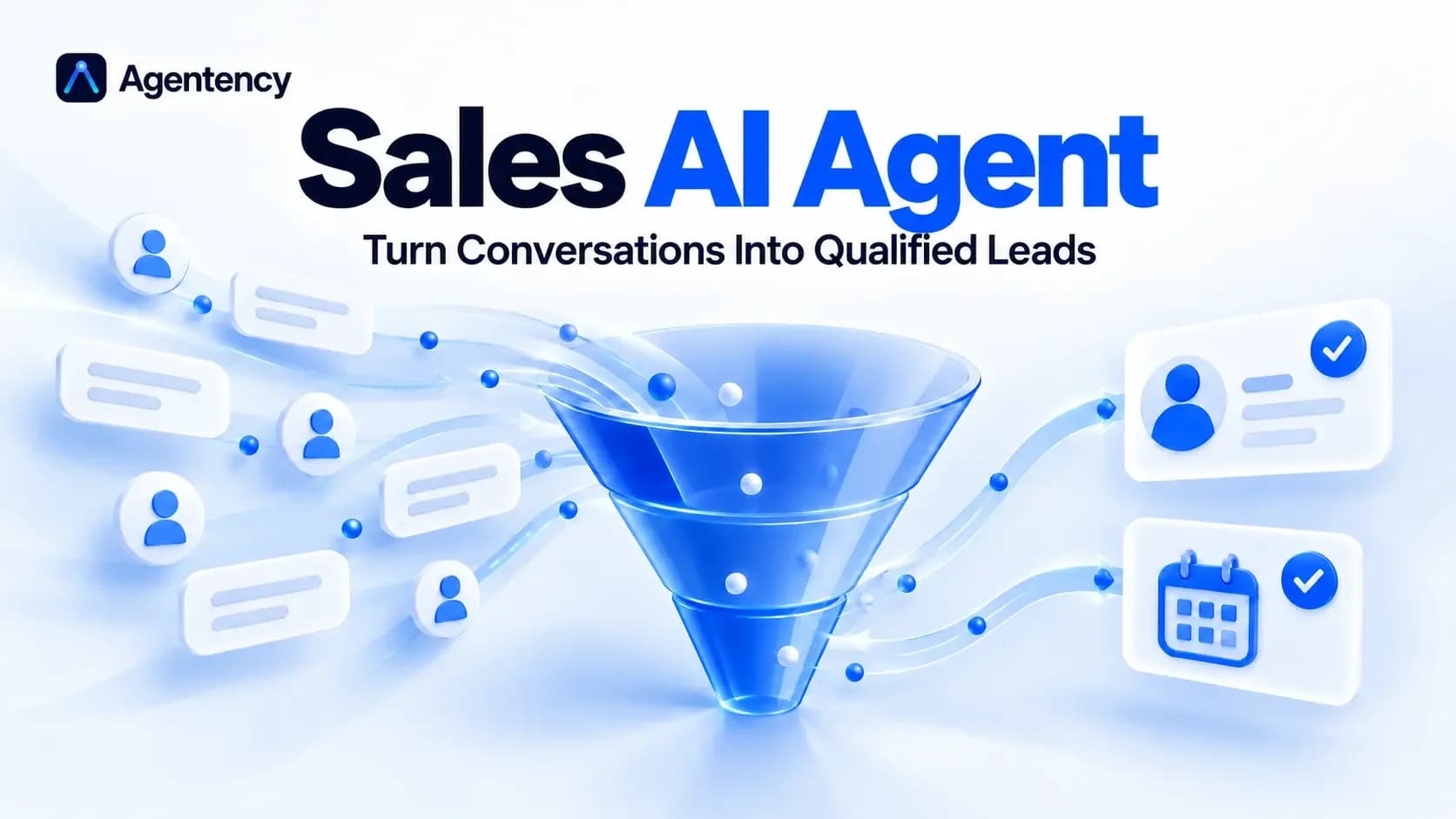
A sales AI agent is software that uses a large language model to handle sales conversations on its own. It answers buyer questions from your own content, qualifies leads against your criteria, books meetings and captures contact details, then hands the conversation to your team when a deal needs a human judgment call.
I wrote this guide for businesses whose leads show up in a website chat or on WhatsApp, often after hours. Most articles on this topic are written for enterprise teams with a room full of SDRs. If your buyers message you at 11 pm and hear nothing until morning, this one is for you.
What Is a Sales AI Agent?
Think of it as the part of your sales team that never logs off. It reads what a buyer writes, works out what they need, and takes the next step: an answer, a qualifying question, a booked demo, or a handoff to a person.
The key word is "decides." A scripted bot follows a decision tree and breaks the moment a buyer asks something off-script. A rules-based workflow runs the same fixed steps every time. An AI sales agent looks at the situation, picks the right action, and adjusts when the conversation changes direction. That ability to plan and act is what people mean by agentic AI sales. You'll also hear it called conversational AI for sales.
Some tools run as a fully autonomous sales agent that prospects and sends outreach with no human involved. Others stay inbound and answer the people who already came to you. Gartner predicts that by 2028, 33% of enterprise software applications will include agentic AI, and 15% of day-to-day work decisions will be made autonomously.
Why does this matter for a smaller business? Salesforce research found that reps spend just 28% of their week actually selling. The rest goes to admin, data entry and answering the same questions again and again. Sales AI agents take the repetitive part so your people keep the conversations that need them.
Put a sales AI agent on your site tonight. Train it on your pricing page and FAQs, and let it answer buyers while your team sleeps. Start free, no credit card needed.
How a Sales AI Agent Works
Every AI sales agent is built from the same four parts.
The model
The large language model reads the buyer's message and writes the reply. It's the brain, not the whole agent. On its own, it doesn't know your prices, your delivery times or which plan includes SSO.
Your sales knowledge
This is what the agent answers from: your website, pricing page, sales deck, FAQs and policies. Better content, better selling. Garbage in, garbage out still applies.
Actions
Actions are what separate an agent from a talking FAQ. A good agent can book a meeting, capture a lead's name and phone number, check stock, send a payment link, or write a record into your CRM. Without actions, the conversation ends in the chat window and nothing happens afterwards.
Rules and handoff
Rules tell the agent what it may and may not do:
- Never promise a custom discount.
- Always ask for company size before booking a demo.
- Hand over to a human when a buyer mentions a contract.
The handoff is where the lead reaches your team, ideally with the full conversation attached so nobody asks the buyer to repeat themselves.
Speed is the reason all of this matters. In the Lead Response Management study by Dr. James Oldroyd and InsideSales.com, leads contacted within five minutes were 21 times more likely to qualify than leads contacted after 30 minutes. A human team cannot answer every message in five minutes, at night and on weekends. An agent can.
Sales AI Agent vs AI SDR vs AI BDR vs AI Sales Assistant
Vendors use these terms however suits their pitch. Here's how I separate them.
| Term | What it does | Best for |
|---|---|---|
| AI sales agent | Talks to buyers, decides the next step, takes actions like booking and lead capture | Inbound questions on your site and messaging apps |
| AI SDR | Handles early pipeline work: outreach, first qualification, meeting setting | Teams that want to automate SDR tasks |
| AI BDR | Finds and contacts new prospects, usually by email and LinkedIn | Outbound prospecting at volume |
| AI sales assistant | Helps a human rep: drafts emails, summarizes calls, suggests next steps | Reps who stay in control |
| Sales chatbot | Answers from a script or decision tree | Simple, predictable questions |
| Sales automation | Runs fixed steps, like "form fill, then email, then task" | Processes that never change |
A virtual sales assistant usually means the same thing: a tool that supports a person rather than replacing one. You will also see "AI salesperson" and "AI sales representative" in ads. Those are marketing labels, and they usually describe an autonomous outbound tool. An AI lead generation chatbot that only collects a name and email sits closer to the chatbot row.
The simplest test: does it act on its own, or does it wait for a human to tell it what to do?
- If it acts, it's an agent.
- If it waits, it's an assistant.
- If it only follows a script, it's a chatbot.
You can see what the agent side looks like in practice on Agentency's features page.
What a Sales AI Agent Does
Most AI agents for sales are sold on one headline feature. Real buyers need several things in one chat.
Answers pricing and product questions
This is where most inbound sales conversations start. These are the kind of messages buyers actually send:
- "Can we get a live demo Friday morning? We're three people, 30 minutes max."
- "We're 40 people. Is Team or Business the plan with SSO? The site is vague."
- "We're on another helpdesk today. Do you import old conversations or do we start empty?"
None of these need a salesperson. They need a fast, correct answer.
Lead qualification
A good agent asks the questions your team would ask on a first call: company size, use case, timeline, budget. AI lead qualification happens in the flow of the conversation, not in a ten-field form nobody wants to fill in. By the time a human joins, the basics are covered.
Books demos and meetings
The agent finds a free slot, books it and confirms in the chat.
Handles competitor objections
Upload your comparison pages and the agent can answer "why you over X?" with facts you approved. It's often the question that decides the deal.
Follows up and passes the lead on
AI sales follow up means the lead doesn't die when the chat ends. The agent collects contact details, sends a summary and the transcript to the right person, and routes sales, support and billing questions to different inboxes.
Sells and supports in the same chat
Buyers don't separate sales from support. Someone asks "do you ship to Egypt?" and then "do you offer installments?" in the same thread. One agent should handle both, so the buyer never gets bounced between a sales bot and a support bot.
Outbound and AI prospecting
Outbound tools research lists, write emails and send sequences. That kind of AI lead generation is useful, but it's a different job with different risks, which I cover in the rules section below.
Industry examples
- Real estate: teams reply to listing enquiries the moment they arrive and book viewings.
- Online stores: answer stock questions and send payment links on WhatsApp.
- SaaS: answer plan and integration questions.
- Hotels: take booking requests at midnight in the guest's language.
Why a Good Sales AI Agent Says "I Don't Know"
Here's the part most vendors skip. An agent that makes things up is worse than no agent, because it's making promises in your name.
In February 2024, a Canadian tribunal ruled against Air Canada in Moffatt v. Air Canada. The airline's chatbot told a customer he could claim a bereavement fare refund after his trip, which was not the airline's policy. Air Canada argued the chatbot was responsible for its own actions. The tribunal disagreed and ordered the airline to pay about C$812 in damages, interest and fees. Small amount, big lesson: whatever your agent says, you said.
This is also why sellers don't fully trust AI for sales yet. BCG surveyed 400 US sales reps and managers. Roughly seven in ten sellers use general-purpose AI tools for tasks like drafting emails and summarizing calls. But more than four in five cite inaccuracy and poor data integration as obstacles. About three in four feel under-supported in using the technology.
So what does a trustworthy sales AI agent look like?
- It answers only from content you approved.
- It checks that what it found is relevant, not just similar-sounding.
- It has a confidence floor. If nothing clears the bar, it says it doesn't know and hands the question to a person.
- It shows you the source behind every reply, so you can check its work.
That brings up the question every sales team asks: AI SDR vs human SDR, which wins? Neither, on its own. The agent is great at volume and speed. A human is better at multi-stakeholder deals, negotiation and trust. The setup that works is the agent handling the first touch and the repeat questions, and your people taking over when judgment matters.
Answer every lead in minutes, not hours. Build an agent that answers only from your content and hands hard questions to your team. Try it free.
Sales AI Agent Rules in the US, UK, Canada and Saudi Arabia
Most guides mention "GDPR and CCPA" in one line and move on. Some even say customers won't know you use AI unless you tell them. That advice can get you into trouble. Answering a buyer who messaged you first is usually fine. Sending unsolicited marketing is where the rules bite, and they differ by country.
United States
If your agent makes phone calls with an AI voice, the TCPA applies. On February 8, 2024, the FCC unanimously ruled that AI-generated voices count as "artificial" under the Telephone Consumer Protection Act. That means you need prior express consent before an AI-voiced call. The FCC's announcement on AI-generated voices in robocalls is worth reading before you try cold calling AI.
California adds its BOT Act. Since July 1, 2019, it has been unlawful to use a bot on large online platforms to mislead people about its artificial identity in order to sell to them. Disclose clearly and you are covered. My advice: disclose everywhere, in every state.
United Kingdom
Under PECR, "electronic mail" is broader than email. It includes texts, in-app messages and direct messages on social media. So an agent that sends marketing on Instagram or WhatsApp is doing regulated electronic marketing. You need consent or the "soft opt-in," which only covers your own customers and never bought-in lists. The ICO's guidance on direct marketing using electronic mail explains the difference between a buyer asking you for information and you sending marketing they never asked for.
Canada
Canada's Anti-Spam Legislation (CASL) requires consent before you send a commercial electronic message, and it covers emails and texts. Consent can be express or implied, for example from a recent purchase or enquiry. Every message needs your identity and an unsubscribe option. Penalties reach up to C$10 million for businesses. The Government of Canada's guide to consent under CASL is the place to start. Canada is also where the Air Canada chatbot case happened, which makes it a good reminder that what your agent promises counts.
Saudi Arabia
Saudi Arabia's Personal Data Protection Law (PDPL) is enforced by the Saudi Data and Artificial Intelligence Authority (SDAIA). It restricts sending advertising to someone's personal contact channels, such as email, without their consent. That consent must be freely given, documented and easy to withdraw. Fines can reach SAR 5 million. You can find the law and its implementing regulations on SDAIA's regulations and policies page. For Saudi businesses, the bigger sales opportunity is language: buyers expect answers in Arabic. If you sell on Salla or Zid, your agent can also connect to your store.
AI Sales Agent Pricing: Per Seat, Per Month or Per Message
Pricing varies more here than in almost any software category I have looked at. According to Fin's 2026 comparison of AI sales agents:
- Qualified's Piper runs around $40,000 to $68,000 a year.
- 11x runs $5,000 or more a month.
- AiSDR starts at $900 a month for 1,200 messages.
Those prices make sense for enterprise outbound teams with big deals. Not for a clinic, a store or a 10-person SaaS company.
The other model is paying per message instead of per seat. On Agentency, for example:
- Starter is $19 a month for 500 messages.
- Standard is $99 for 4,000 messages, which works out to about 2.5 cents per message.
- Pro is $249 for 15,000 messages.
There are no per-seat fees. Even if a qualifying conversation used 10 messages, that's roughly 25 cents to turn a question into a lead. You can compare every plan on the pricing page.
Whatever tool you look at, ask: what does one qualified conversation cost me?
How to Build an AI Sales Agent Without Code
You don't need a developer or an integration project. Here's the setup I'd follow, and it fits in an afternoon.
Step 1: Pick one job
Start with one job, like answering pricing questions or booking demos. One clear job is easy to test. An agent that does everything is hard to fix when it goes wrong.
Step 2: Add your sales knowledge
Crawl your website, upload your pricing sheet and deck as PDFs, and paste your FAQs. Add your competitor comparison pages too. If your sales team answers it more than twice a week, it belongs in the knowledge.
Step 3: Write your rules
Write the rules in plain language. What questions should it ask before booking a demo? What must it never promise? When should it hand over to a person?
Step 4: Test before anyone sees it
Use a private preview and ask the questions your team is tired of answering. Check every answer and its source. If an answer is weak, fix the document behind it, then ask again.
Step 5: Go live on your channels
Add the widget to your site and connect WhatsApp, Instagram or Messenger. One knowledge base serves every channel.
Step 6: Review what it couldn't answer
Every week, check the questions the agent couldn't answer. Each one is missing sales content. Add the answer once and the next buyer gets it. You can see the full setup loop on how Agentency works.
How Agentency Runs Your Sales AI Agent
I'll be honest about where Agentency fits. Most AI agents for sales are built for outbound teams. Agentency is built for inbound: the buyers who already came to your website, WhatsApp or Instagram with a question. It is not an outbound email sequencer.
You start from the Sales template and train the agent on your website, documents, Google Drive, OneDrive or Dropbox files, and FAQs. It answers in more than 90 languages, detected per message, Arabic included. Every reply is grounded in your own content, runs through two-stage retrieval with a reranker, and shows the source it used. If nothing clears the confidence floor, it says it doesn't know and logs the question.
On the action side, the agent can capture and qualify a lead, save it to your CRM and alert sales. It can book meetings, check stock, send payment links and track orders. It connects through Zapier, Make and the API, with 31 ready-made action templates and OpenAPI import. See the full list of integrations.
When a buyer asks for a person, a quote or a callback, the agent collects their name, email and phone. It then emails your team a lead summary with the full transcript. Sales, support and billing can go to different inboxes. No CRM login needed, which matters for a small team.
It runs on your website widget, plus WhatsApp through the official Business API, Instagram, Messenger, Telegram, Slack, Discord, LINE, Viber, WeChat and SMS. You can also choose the AI model behind your agent and try a second one in testing before visitors ever see it. For a closer look at the sales setup, see Agentency's page on the AI agent for inbound sales.
How to Tell If Your Sales AI Agent Is Working
Write down your current numbers before you switch it on. Without a baseline, you can't prove anything changed. Then track:
- Speed to lead: how fast every new enquiry gets a first reply.
- Qualified conversation rate: how many chats end with a qualified lead.
- Resolution rate: how many questions it answered without help.
- Escalation rate: how often it hands over to your team.
- Meetings booked: straight from the chat.
- Unanswered questions: the list that tells you what to add next.
Final Thoughts
A sales AI agent is not magic, and it won't replace a good salesperson. What it does is make sure no buyer waits until morning for an answer your website already has. Start with one job, train it on your real content, write clear rules and review what it misses every week. That's how AI sales agents earn their place in your team.
Sales and support in one agent. Train it on the content you already have and go live on your website and WhatsApp in minutes. Start free. Free plan, no credit card, cancel anytime.
Disclaimer: This article is for general information only and is not legal advice. Rules change, so check with a qualified advisor in your country before running any AI outreach.
About the Author
Omar El Bahr is a Senior Digital Growth Specialist working on SEO, content, and digital growth, and a contributor to the Forbes Communications Council. He writes about AI chatbots, search, and how growing businesses can put new technology to practical use.
Frequently asked questions
How do sales AI agents work?
Sales AI agents combine a large language model, your sales content, a set of actions and your rules. The model reads the buyer's message, the agent finds the answer in your content, takes an action like booking a meeting, and hands off to a human when a rule says so.
Can AI sales agents replace a human SDR?
They can take over a lot of SDR tasks, like first replies, basic qualification and booking. They can't replace the relationship work and judgment that close bigger deals.
Will AI take over sales jobs?
AI will take over the repetitive parts of sales jobs. Building trust, reading the room and handling complex deals stay human. BCG's research says most of the value comes from people and processes, not the technology alone.
What is the difference between a sales AI agent and a chatbot?
A chatbot follows a script. An AI sales agent understands the question, decides what to do next and takes action, like booking a demo or saving a lead. If a buyer goes off-script, the chatbot breaks and the agent adapts. An Agentency agent, for example, answers off-script questions from your own content instead of breaking.
How much do sales AI agents cost?
In some places, yes. California's BOT Act requires disclosure when a bot on a large online platform is used to sell. Even where it isn't required, I recommend it. Buyers find out anyway. Inbound agents priced per message cost a few cents each. On Agentency, paid plans start at $19 a month with no per-seat fees.
Can AI sales agents update my CRM?
Yes, if they support actions. Many agents can save leads and update records in your CRM directly or through tools like Zapier and Make. Check this before you buy, because without it someone still has to copy data by hand. Agentency does this through Zapier, Make and the API, and can also email each lead straight to your team.
What features should I look for in a sales AI agent?
Look for: - Answers grounded in your content, with sources - A clear handoff to your team - Lead capture and meeting booking - CRM or email routing - Support for your buyers' channels - A report of unanswered questions Agentency covers every item on this list, so it's a fair benchmark for any tool you compare.
What is an AI SDR?
It's an AI agent that does the work of a sales development representative: early outreach, first qualification and meeting setting. It's one type of AI sales agent, usually aimed at pipeline generation.
Can one agent handle both sales and customer support?
Yes, and for most small businesses it should. Buyers mix both in the same chat, so one agent trained on both avoids passing them between two bots. Buyers mix both in the same chat. That's how Agentency is set up: one agent, one knowledge base, every channel.