AI Agents for Business: What They Are and Real Examples
What an AI Agent Actually Is, in Plain Terms
Most articles about AI agents for business describe the same imaginary company. It is always “a leading retailer” or “a global enterprise,” and it is never named, because it does not exist. That is the tell. If an example cannot survive being made specific, it was never a real example to begin with.
This piece is going to name names where a name is actually available, and be upfront about it when one is not. Ai agents for business only means something once you can point at a real one doing a real job, not a paragraph describing what one theoretically could do. Search ai agents examples and you will find plenty of lists, most of them built from the same handful of vague, unverifiable claims recycled across a dozen different blogs.
That recycling is worth noticing on its own. When five different articles describe the exact same unnamed “Fortune 500 company” using an AI agent to cut costs by some suspiciously round percentage, none of them actually checked the claim. They copied it from each other. This piece tries not to do that.
The One Sentence Version
An AI agent is software that can plan a task, use tools to carry it out, and complete multiple steps toward a goal without someone approving each step along the way. A chatbot answers a question. An agent goes and does the thing the question was actually about, whether that means looking something up, updating a record, or finishing a task that used to require a person clicking through several screens.
That distinction is the whole reason ai agents examples are worth collecting in the first place. A screenshot of a chat window proves a bot can talk. It does not prove anything acted. The examples worth trusting are the ones where something in the real world actually changed because the agent did something, not just said something.
Why “Agent” Gets Used Loosely
Plenty of products calling themselves agents are closer to a well dressed chatbot than to anything that plans and acts on its own. This is not usually dishonesty, agentic capability is genuinely a spectrum, and a product can sit anywhere along it. But it means the word on a landing page tells you less than you would like, and it is exactly why real, verifiable ai agents for business examples matter more than another definition.
A useful test cuts through most of the confusion. Ask what happens after the software replies. If the answer is nothing, a person still has to go do the actual thing, you are looking at a chatbot with agent branding. If the answer is that something in a real system already changed, an order updated, a ticket created, a meeting booked, you are looking at something that has actually earned the word.
Ready to see what a working example looks like instead of reading about a hypothetical one? Start free with Agentency.
Real Examples, Not Hypotheticals
Here are a handful of ai agents examples that are actually named, actually shipped, and actually measured, not projected.
Legal Work Getting Done Faster
Thomson Reuters built an agentic assistant for legal teams that reviews documents, drafts research memos, and summarizes case files. The company reports its own customers seeing something close to a one third average reduction in time spent on document review, research, and drafting. That is a specific, checkable claim about a named product, not a hypothetical about what legal AI could someday do.
Notice what actually changed in that example. A lawyer or paralegal used to spend hours reading through case files by hand. Now the agent reads them first, surfaces what actually matters, and the human reviews a shorter, more focused set of findings instead of starting from a blank page. That is the pattern worth extracting, not the specific industry. The task got shorter because something acted on it, not because someone described it more efficiently.
HR Requests Nobody Has to Chase Down
IBM built an internal tool called AskHR that the company says fully automates more than eighty common HR requests, things like leave balances, policy questions, and benefits enrollment steps that used to sit in someone’s inbox for days. This is a genuinely unglamorous example, and that is exactly why it counts. Most of what an AI agent for business actually does is unglamorous, repetitive requests, handled without anyone waiting on a reply.
A Coding Partner Actually Shipping Code
IBM also built a coding agent called Bob, currently used by roughly ten thousand of its own developers, with the company reporting a forty five percent productivity increase among the people using it. Software development is one of the categories where agentic tools have moved past simple autocomplete into something that can explore a codebase, make a change, and run tests against it with much less hand holding than a year or two ago.
Financial Institutions Recovering Real Working Hours
A World Economic Forum report on agentic AI pilots across financial institutions found a cluster of well designed pilots collectively saved an estimated thirty thousand workdays, with productivity improvements ranging from twenty to nearly sixty percent on administrative tasks like documentation and preliminary analysis. That range is wide because the tasks were different across institutions, but the pattern held across all of them: real hours recovered, measured after the fact, not projected before launch.
Newsrooms and Robotics Labs, Two Very Different Uses
The Associated Press has used AI for years to generate straightforward, data driven articles, sports scores and financial earnings reports, freeing its actual reporters for stories that need judgment rather than arithmetic. At the other end of the spectrum, engineers at NASA’s Jet Propulsion Laboratory built an open source agent called ROSA that lets robot developers inspect and operate robotics systems using plain language instead of specialized command syntax. Neither of these ai agents examples has anything to do with the other’s industry, which is really the point. The underlying idea, an agent that plans and acts rather than just replies, shows up in wildly different places once you start actually looking for it by name instead of by category.
Where AI Agent Startups Fit Into This
Alongside the IBMs and Thomson Reuters of the world, a wave of ai agent startups has built entire companies around one narrow slice of this same idea, a scheduling agent, a research agent, a customer support agent, each one betting that doing a single job extremely well beats trying to do everything passably. Some of these startups will become real platforms. Most will get acquired or folded into a larger product within a few years, which is worth knowing before you build a critical process around one that has only existed for six months.
The honest way to think about ai agent startups is the same way you would think about any young vendor. A clever narrow feature is genuinely useful today. Whether the company still exists in its current form in three years is a separate question, and one worth asking before a single new tool becomes load bearing for a process your business runs every single day.
What This Looks Like for a Small Business, Not an Enterprise
Every example above came from a company with its own engineering department and a budget that starts with a comma in a place most small businesses never see. That gap is worth naming directly, since it is exactly where most content about ai agents for business quietly stops being useful to the person actually reading it.
The Same Categories, a Different Scale
The categories do not actually change much between an enterprise and a small business. Someone still has to answer repetitive questions, someone still has to check an order or a booking, someone still has to hand a complicated situation off to a real person. What changes is scale and budget, not the underlying job. Ai agents for small business does not need to mean a smaller, weaker version of an enterprise tool. It usually means the exact same idea, applied to the handful of repetitive tasks that already eat its week, without the enterprise price tag attached.
The budget gap is worth being direct about, since it is the actual reason most small business owners assume this topic is not for them. A ten thousand developer coding agent obviously is not. A no-code platform billed monthly, doing the same category of task at a fraction of the scale, genuinely is. Our pricing page shows what that actually costs at small business scale, rather than the enterprise numbers most articles on this topic quote by default.
A Concrete WhatsApp and Storefront Example
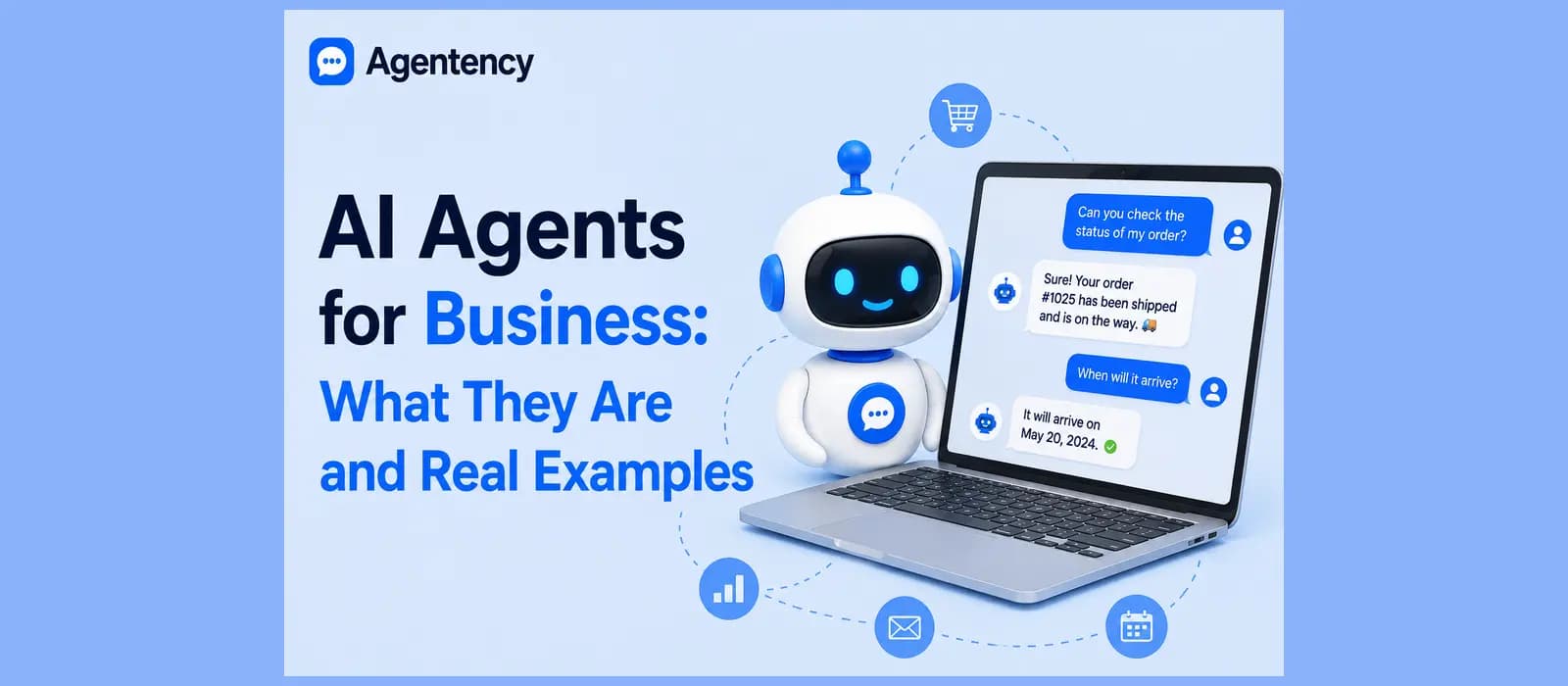
Picture a shop running its storefront on Salla or Zid, taking most of its customer messages through WhatsApp. A customer asks where an order is. The realistic version of an AI agent for business, at this scale, looks up the actual order in the actual storefront, confirms the actual status, and replies with a real answer instead of a template response written before the order even existed. Nobody needed to build that from scratch. It needed to be configured, once, and it keeps running the same way every day after.
Multiply that single interaction by however many times a week the same three or four questions come in, order status, return eligibility, whether a product is back in stock, and the actual time saved starts to look a lot like the enterprise examples earlier in this article, just measured in hours of one person’s week instead of thousands of workdays across a whole institution. The scale is different. The shape of the win is identical.
If you want the fuller comparison between something that only replies and something that actually acts this way, our breakdown of the difference between an AI agent and a chatbot covers exactly that line.
Curious what that actually looks like connected to a real storefront instead of a demo? See Agentency’s integrations.
What Makes an Example Worth Trusting
Not every list of ai agents examples deserves the same weight, and it is worth being explicit about what separates a good one from a recycled one before moving on to what this means for a smaller business.
The Three Question Test
Ask three things about any example before repeating it. Is there a name attached, a real company or product, not “a leading provider.” Is there a specific number, not a vague “significantly improved,” and does that number come with any indication of how it was measured. And can you actually find the claim somewhere other than the article currently making it. If an example fails more than one of those three questions, it is decoration, not evidence.
Most of the ai agents examples circulating in generic listicles fail at least the third question. They read cleanly, they sound plausible, and nobody involved in writing them actually traced the number back to where it came from. That does not make agentic AI any less real. It just means the specific claim in front of you has not earned your trust yet, and treating it as settled fact before checking is exactly how bad statistics spread from one SEO article to the next for years.
Run the test against the examples earlier in this piece and they hold up reasonably well. Thomson Reuters, IBM, and the World Economic Forum are all named sources attached to specific numbers, and each one is checkable against something outside the article repeating it. That is a meaningfully higher bar than most lists of ai agents examples clear, and it is worth applying the same bar to any new example you come across after finishing this one.
Ai agents for business operations is really its own, more specific question than the general one this article opened with, and it deserves a straight answer rather than another list of buzzwords.
Where AI Agents Fit Into Business Operations Specifically
Ai agents for business operations is really its own, more specific question than the general one this article opened with, and it deserves a straight answer rather than another list of buzzwords.
Automating the Whole Process, Not Just Answering About It
The difference between a helpful chatbot and a genuine operations agent is whether it finishes the process end to end or just describes it. A support ticket that gets created, assigned, and updated automatically is operations. A chatbot that tells a customer how to submit a support ticket themselves is not, even though both look similar from the outside for the first ten seconds of the conversation.
Ai agents for business process automation specifically means chaining several of those steps together without a person restarting the process at each handoff. Order comes in, agent checks inventory, agent confirms with the customer, agent updates the record, done. Each individual step might look small enough that nobody would bother automating it alone. Chained together, they add up to hours of a real person’s week, every single week, for as long as the business keeps running that process by hand instead.
This is also where evaluating whether an agent is actually doing its job matters, not just whether it sounds convincing while doing it. Our piece on AI agent evaluation covers exactly how to check that the process actually finished, rather than trusting that a polished reply means the work got done.
How Agentency Handles AI Agents for Business
We get asked constantly what an actual, working ai agents for business example looks like on our own platform, rather than in someone else’s case study. It is a fair question, and the honest instinct is to answer it with something you can actually go look at rather than another paragraph of description.
Call Actions as the Working Example
Agentency’s agents act through Call Actions, real, model invoked tools triggered mid conversation: looking up an order and checking its status, tracking a shipment, creating or updating a support ticket, booking a meeting, or handing a conversation to a person with full context attached. Every one of those is a genuine action in a connected system, the exact distinction this whole article has been drawing between an agent and a chatbot that only talks about the same task.
Line these up against the ai agents examples earlier in this piece and the shape is the same, just at a different scale. IBM’s AskHR automates HR requests so nobody sits in a queue. Call Actions automates order lookups and ticket creation so a small business owner is not doing that by hand at eleven at night. The underlying idea, act instead of just answering, does not change size along with the business using it.
This is set up through a no-code wizard, not a development project. If you have not built one yet, our no-code chatbot builder guide walks through exactly what that setup looks like, start to finish, without needing anyone on a payroll who writes code for a living.
What to Verify in Your Own Setup
Working note for internal review, to be removed before this goes live: the exact planning depth behind Call Actions, meaning how many steps an agent can chain together before it needs a person, needs direct confirmation before this section claims anything beyond what is already documented.
If you want to see a real, working example instead of reading about someone else’s, this is the fastest way to get one running. Start free with Agentency.
Key Takeaways
- An AI agent plans a task, uses tools to act on it, and completes multiple steps toward a goal without a person approving each one. A chatbot only replies.
- Real ai agents examples are named and measured, not a paragraph about an unnamed “leading enterprise.” If an example cannot survive being made specific, treat it with suspicion.
- The categories of work an agent handles do not change much between an enterprise and a small business. The scale and budget do.
- Ai agents for business operations means finishing a process end to end, not just describing the process to a customer and leaving the rest to them.
- Ai agent startups are worth watching but worth treating carefully, since many bet everything on one narrow use case that may not exist in its current form a few years from now.
Frequently asked questions
What are some real examples of AI agents in business?
Named, measurable examples include Thomson Reuters’s legal research assistant, which the company reports cuts document review and drafting time by roughly a third, and IBM’s internal AskHR tool, which the company says automates more than eighty common HR requests without a person handling each one individually. A World Economic Forum report on agentic AI pilots at financial institutions similarly documented an estimated thirty thousand workdays saved collectively. All three share the same trait worth looking for in any example, a named source and a specific, checkable number.
What’s the difference between an AI agent and an AI assistant?
The terms overlap heavily in casual use, but an AI agent generally implies more autonomy: planning steps and acting on them with less human approval along the way, while an AI assistant more often waits for a direct instruction before doing anything at all. In practice, plenty of products blur this line on purpose, since “agent” tends to sound more impressive on a pricing page than “assistant” does, regardless of what the product actually does underneath.
Can a small business actually use an AI agent, or is this an enterprise-only thing?
Small businesses can absolutely use one, and often for exactly the same underlying tasks enterprises use them for, checking an order, answering a repetitive question, updating a record, just at a scale a no-code platform handles without an engineering team. The categories of work barely change between the two. What changes is the size of the budget and the size of the team needed to run it, both of which shrink dramatically once the agent is configured rather than custom built.
What are AI agent startups, and should I use one instead of an established platform?
AI agent startups are companies built around one narrow use case, often something genuinely clever. They are worth considering, but worth checking for staying power first, since a young startup betting on a single feature is a riskier foundation for a process your business depends on daily than a platform with a broader base already running. Ask how long the company has actually been operating and how many real customers depend on it today, not just how impressive the demo looks.
How do AI agents fit into business process automation specifically?
An AI agent handles business process automation by completing an entire task end to end, from recognizing what a customer needs to actually finishing the action, rather than simply explaining the steps and leaving a person to carry them out manually. The test worth applying to any specific claim is whether the process actually finished on its own or whether a human still had to do the last, most important step by hand.