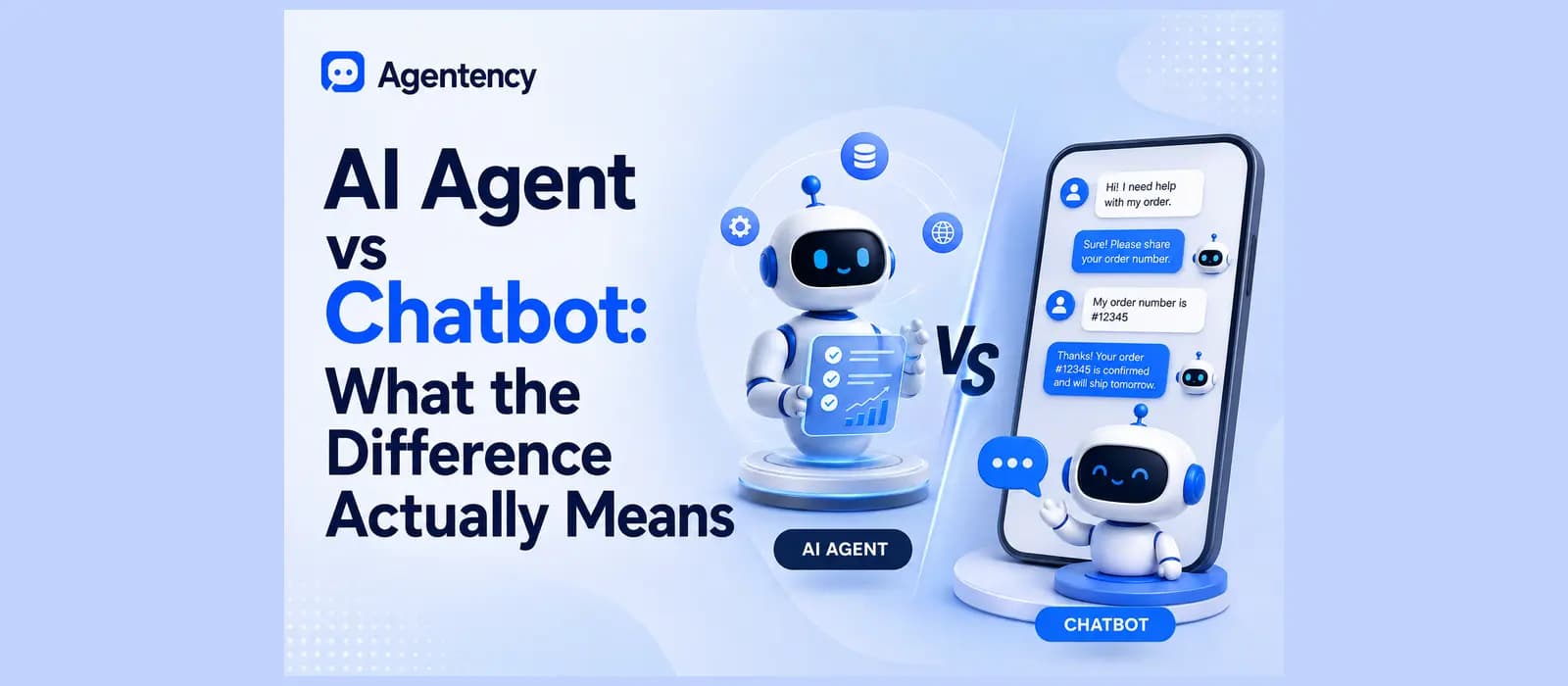
AI Agent vs Chatbot: What the Difference Actually Means
What AI Agent and AI Chatbot Actually Mean
Read enough vendor homepages in a single sitting and you start noticing something. The exact same chat widget that called itself a chatbot in 2023 calls itself an agent in 2026, and the product underneath rarely changed as much as the name on the box did.
That is not always dishonest. Sometimes the product genuinely got smarter. But it means the label has mostly stopped telling you anything useful, and if you are trying to settle an ai agent vs chatbot question about the software behind your own support chat, the vendor’s marketing page is the last place to look for an honest answer.
Here is the actual test, the one that cuts through the relabeling. Can it take an action in a system nobody specifically built it for, on its own, without a person clicking anything. If yes, you are looking at an agent. If it can only produce a reply, however smart that reply sounds, you are looking at a chatbot, whatever the box says.
This piece assumes you already have a general sense of what a customer service chatbot does. If you want that fuller picture first, our guide to customer service chatbots covers it properly. What follows here is specifically about the word people put in front of it, agent or chatbot, and why that word matters more than most shoppers realize.
The One Question That Actually Separates Them
A chatbot tells a customer how to reset a password. An agent resets it, logs the change, and sends the confirmation, without a human touching any step in between. Same conversation on the screen. Completely different thing happening behind it.
This is why ai agent vs ai chatbot debates get confusing so fast, and why chatbot vs ai agent comparisons written from the opposite angle land on the exact same answer. Both can sound equally natural in a chat window now. Both can answer a question about your return policy in the same friendly tone. The gap only shows up the moment the conversation needs something to actually happen somewhere else, in an order system, a CRM, a calendar.
A chatbot describes the next step. An agent takes it. That single sentence resolves most of what gets written up as a complicated technical distinction, and it is really the entire ai agent vs chatbot difference once you strip out the marketing language sitting on top of it. It also explains why so many “talk to a live agent” buttons in chat widgets are a little misleading. Half the time, clicking that button hands you off to a human agent because the software behind it never had the tool access to finish the job itself, not because a person was strictly necessary for the task.
Why Every Vendor Calls Their Product an Agent Now
Part of this is real progress. Large language models genuinely made it possible to plan a task, call a tool, and check the result, which older rule based systems could never do. Part of it is just that “agent” sells better than “chatbot” does this year, the same way “cloud” sold better than “server” a decade ago.
The practical result is that the word on a pricing page tells you almost nothing about what is actually running underneath it. Ask any vendor claiming to sell an agent the same question you would ask about anything else you are buying. What does it connect to, and what can it do there without asking you first.
Curious what a genuinely tool connected agent looks like in practice rather than in a marketing headline? See what Agentency’s agents can actually connect to.
Chatbots, Ranked by How Much They Actually Do
Not every chatbot is the same kind of thing, and lumping them together is part of why this whole comparison gets muddy. There is a real range here, from a decision tree with a friendly face to something that genuinely reasons about language.
Rule Based Chatbots
The oldest and simplest version runs on if and then logic. Did the message contain a specific keyword. Is it currently outside business hours. Each rule branches to a fixed response, and if none of the rules match, the bot falls back to something generic like “sorry, I did not understand that.”
Picture a small flowchart. Rule one checks for a keyword and branches to response A or response B. Rule two checks the time of day and branches to a different response, or a default one if neither rule fires. That is the entire brain of a rule based chatbot. It never learns anything new on its own, and every fix requires someone to go in and add another branch by hand.
A rule based chatbot vs ai chatbot comparison is really where most of the confusion in this whole topic starts, because plenty of products still sold as “AI chatbots” are closer to this end of the spectrum than their marketing suggests. If a system’s entire personality is a set of if and then branches, adding a friendlier tone of voice on top does not move it any closer to being an agent.
A Note on “Virtual Agent” and “Bot”
Two more words get thrown into this mix constantly, and neither one is as precise as it sounds. “Virtual agent” usually just means a chatbot with better branding, a chatbot vs virtual agent comparison, run honestly, almost always comes back to the exact same test as chatbot vs agent. Whether something calling itself a virtual agent is genuinely one comes down to tool access, not the name on the widget. And “bot” is really the generic umbrella both of these other terms sit under. An ai agent vs bot question and an ai agents vs bots question are both asking the same thing in fewer words: is this specific bot smart enough to act, or is it only smart enough to talk.
LLM Chatbots, the Ones Most People Actually Mean by AI Chatbot
Most products people call an ai chatbot today are actually this second kind. A large language model reads the message, understands it far more flexibly than keyword matching ever could, and generates a natural sounding reply, usually grounded in a knowledge base through retrieval so it is not just making things up. The difference between chatbot and ai chatbot, in the plain sense most people mean it, is really the difference between that first rigid rule based system and this one: language understanding versus keyword matching.
This is a real improvement, and it covers a lot of ground. It handles rephrased questions, unusual wording, and multiple languages without anyone writing new rules. What it still does not do, on its own, is act. It answers in a single request and response pattern. No tool calls, no follow up steps, no memory that carries meaningfully across the conversation beyond what is already on screen.
Where the Line to Agent Actually Gets Crossed
The honest version of this line is blurrier than most comparison pages admit. Give an LLM chatbot exactly one tool, say, the ability to look up an order status, and it starts behaving like an agent for that one task while still reading like a chatbot for everything else.
That is really the useful way to think about it. Not chatbot versus agent as two separate boxes, but a spectrum, where the distance you have moved along it depends entirely on how many real tools the thing can actually call and how many steps it can chain together before it needs a human.
What Makes Something an AI Agent
If a chatbot’s job is to answer, an agent’s job is to finish something. That distinction sounds small in a sentence and turns out to matter enormously once you watch the two side by side on the same customer request.
Reasoning and Multi Step Planning
An agent does not just retrieve one answer and stop. It works through something closer to a loop: understand the goal, analyze what it already knows, plan a next step, execute that step, evaluate whether it worked, and refine the plan if it did not.
A customer says their order arrived with the wrong item and they need the correct one shipped plus a return label for the mistake. A chatbot answers each part of that separately, if it manages both at all. An agent recognizes two linked tasks, looks up the order, starts an exchange, generates the return label, and reports back once, because it planned the whole thing rather than reacting to it one line at a time.
Tool Use, or Why Actions Matter More Than Words
This is the actual engine underneath the difference. An agent that can call a database, a CRM, an API, and a channel like WhatsApp is not just talking about your business anymore, it is reaching into it. Look up the order in the database. Update the record in the CRM. Confirm the change through the API that runs the storefront. Send the update on WhatsApp, where the customer already is.
None of that requires a human in the loop for the routine cases. It only needs one when something falls outside what it is allowed to do on its own, which is a different problem, and one we cover properly in our guide to chatbot to human handoff.
Memory Across a Conversation, Not Just Within One
A chatbot typically starts fresh every session. An agent can carry real memory forward: that this customer already reported the same issue twice, that an exchange is already in progress, that a particular account has asked about the same feature three times this month. That memory is what lets it act like it has actually been paying attention, rather than greeting a returning customer like a stranger every single time.
Ready to see the difference between a chatbot that replies and an agent that actually finishes the task? Start free with Agentency.
How an Agent Actually Works, Step by Step
Most comparisons stop at the definition and never actually walk through what is happening in the moment an agent handles a request. Worth doing once, because it is the clearest way to see why “reasoning” is not just a buzzword vendors sprinkled onto an ai agent vs chatbot pricing page.
The Goal, Plan, Execute, Evaluate Loop
Strip away the jargon and an agent’s process looks close to this, in order. Understand the goal the customer actually has. Analyze whatever it already knows, from the conversation and from connected systems. Plan a next step. Execute that step by actually calling a tool. Evaluate whether the result solved the problem. Refine the plan and repeat if it did not, or answer the customer if it did.
A rule based chatbot has nothing resembling this loop. It has a lookup table. An LLM chatbot gets partway there because the language model can reason about what a sentence means, but it stops at reasoning about words. An agent closes the loop because it can act on the reasoning and check its own work, not just describe what someone else should do next.
A Worked Example
A customer messages saying their order shipped to the wrong address and they need it redirected before it arrives. A rule based chatbot matches “shipped to the wrong address” to a canned response about contacting support. An LLM chatbot writes a genuinely sympathetic, well phrased explanation of the general redirect policy, and still ends with some version of “please contact our team.”
An agent does something different. It analyzes the request, plans to look up the order, executes that lookup against the order database, evaluates that the shipment has not yet left the warehouse, plans the redirect, executes it through the shipping provider’s API, evaluates that the address updated successfully, and only then responds to the customer, with the actual fix already done rather than promised. If any step had failed, evaluate would have caught it and refined the plan, maybe by escalating to a person instead of pretending the fix worked.
That is the entire distinction this article keeps circling back to, just shown in motion instead of defined in the abstract.
Real Differences That Matter for a Small Business
Architecture diagrams are interesting if you are an engineer. If you are running a store, what actually matters is cost, setup time, and what happens the day something goes wrong.
Cost and Setup Time
A basic chatbot answering FAQs from a knowledge base can be live within a day or two and does not demand much ongoing attention once it is trained on the right content. An agent that connects to a CRM, an order system, and a messaging channel takes longer to configure properly, because someone has to decide exactly which actions it is allowed to take and under what conditions, before it ever touches a real customer.
Neither option is automatically the cheaper one long term. A chatbot that cannot act keeps routing every real request to a person anyway, which means you are paying for software and still paying for the person. An agent that resolves the request end to end removes that second cost, but only on the tasks it was actually set up to handle.
Think about a store that gets a hundred order status questions a week. A chatbot answers all hundred instantly, which already saves real time. But if fifteen of those hundred also need the order actually changed, redirected, or refunded, a chatbot passes all fifteen to a person, every single week, forever. An agent set up to handle order changes closes that gap permanently, once, instead of quietly costing you the same fifteen conversations month after month.
What Happens When It Hits a Wall
This is the part most comparisons skip entirely, and it is the part that decides whether a customer walks away happy or annoyed. A chatbot that hits its limit usually just says it cannot help, or points at a “talk to a live agent” button with no context attached to the click. A properly built agent recognizes the same limit and hands the conversation to a human agent with everything it already knows attached: the transcript, what it already tried, the order number it already pulled up.
The difference between those two outcomes is not really about intelligence. It is about whether escalation was designed as a real feature or bolted on as an afterthought once the demo was already built.
Want to see what a full context handoff actually looks like end to end? Read our breakdown of what a good handoff carries with it.
Chatbot or Agent, How to Actually Decide
Ignore the marketing for a moment and ask what the task in front of you actually requires. The answer to ai agent vs chatbot for customer service is rarely all one or all the other. It is usually both, at different points in the same conversation.
When a Chatbot Is Enough
If the goal is information, not action, a chatbot is genuinely sufficient and often the faster, cheaper choice. Store hours, shipping timelines, a return policy explained clearly, a password reset walked through step by step. None of that needs an agent’s tool access, and building agent level infrastructure for a task this simple adds cost without adding anything the customer actually notices. A chatbot vs conversational agent debate over a use case this narrow is usually not worth having at all. If you have not built one yet, our walkthrough on how to make a chatbot covers exactly this scope.
When You Actually Need an Agent
The moment a task crosses into another system, an agent earns its cost back quickly. Processing an actual refund instead of explaining the refund policy. Rebooking an appointment instead of listing available slots and asking the customer to pick. Updating an order across your storefront and your shipping provider in the same conversation instead of two separate ones. Anywhere a human would otherwise be doing the same repetitive multi step task by hand, an agent is doing real work rather than just talking about it. Our no-code guide to building an agent walks through the setup without needing a developer on the project.
How Agentency Handles This
We get asked some version of ai agent vs chatbot constantly by people evaluating Agentency against everything else on their shortlist, and the honest answer to the ai agent vs chatbot question, for us specifically, is that Agentency is built to be both, depending on what a given conversation actually needs.
Call Actions Are the Agent Part
The part of Agentency that makes it an agent rather than a chatbot with better manners is Call Actions. These are real, model invoked tools an agent can trigger mid conversation: booking a meeting, creating or updating a support ticket, looking up an order or checking its status across your storefront, tracking a shipment, pushing a lead into a CRM, or handing the conversation to a person with full context attached.
Every one of those is a genuine action in a connected system, not a scripted reply describing what the action would involve. That is the actual line this whole article has been drawing, and it is the same line that separates a chatbot from an agent everywhere else in this comparison too.
What to Verify Before You Buy
Working note for internal review, to be removed before this goes live: the exact reasoning depth and planning model behind Call Actions, and how far the memory carries across separate sessions rather than within one conversation, both need direct confirmation. Nothing stated in the Call Actions section above claims more than what is already documented.
If your support setup is still answering questions without ever finishing anything, it might be time to see what an actual agent looks like. Start free with Agentency.
Key Takeaways
- The real test in any ai agent vs chatbot comparison is simple: can it take an action in another system on its own, or can it only describe what should happen next.
- Chatbots range from simple rule based decision trees to genuinely capable LLM chatbots, but neither acts without a human clicking something.
- An agent reasons through a goal, plans steps, calls real tools like a database, CRM, API, or WhatsApp, and carries memory forward across a conversation.
- For a small business, the deciding factor is rarely the technology itself. It is whether the task in front of you needs information or needs something done.
- A well built agent hands off to a human with full context when it hits a real limit. A chatbot usually just stops.
Frequently asked questions
What is the main difference between an AI agent and a chatbot?
A chatbot responds with text. An AI agent takes action in a connected system, like updating an order or processing a return, without a person completing that step manually.
Is ChatGPT an AI agent or a chatbot?
By default, ChatGPT behaves like an LLM chatbot, generating replies from a single request and response pattern. An ai agent vs chatgpt question is really a question about mode, not the underlying model. With tool access enabled, such as browsing, running code, or calling external functions, the same underlying model starts acting like an agent, which is a good example of how blurry the line actually is in practice.
What’s the difference between a chatbot and a virtual agent?
“Virtual agent” is often used loosely as a fancier sounding name for a chatbot, without necessarily adding real autonomy or tool access. Whether something described as a virtual agent is genuinely an agent by this article’s test still comes down to whether it can act on its own, not what it is called.