Conversational AI Platforms: 8 Best Picks for Small Teams

Key takeaways
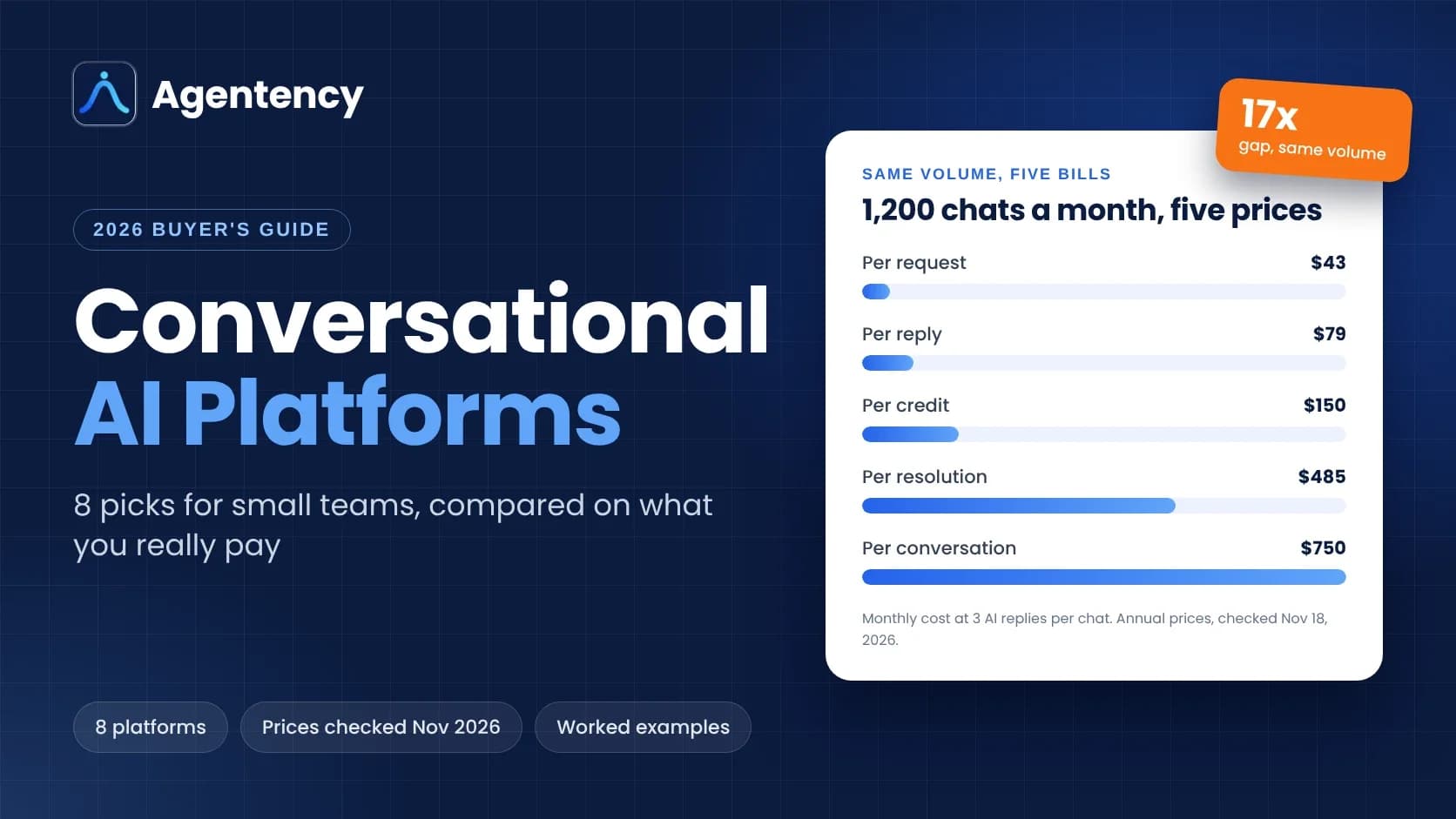
- A store handling 1,200 chats a month (3 AI replies each) pays $79.17 a month on Agentency Standard, $150 on Chatbase Basic and $750 on Botpress Team, at annual prices checked on November 18, 2026.
- The pricing unit decides your bill more than the headline price: per reply, per conversation, per resolution, per contact or per minute.
- Since October 1, 2026, Meta charges for WhatsApp service messages after the first 1,000 per phone number each month, on top of any platform fee.
- In a Gartner survey published in 2024, 64% of customers said they would prefer companies didn't use AI for service, so the platform you pick has to show its sources and reach a person fast.
Build your first AI agent free → · Free forever plan, no sales call needed.
It's 11:40 at night.
Your phone buzzes. Then again.
"Does the Harlow sofa come in grey?"
"How long is delivery?"
"Can I return it if it doesn't fit?"
You know every answer. They're all on your website. And you still type each one by hand, because the alternative is a customer who buys the sofa somewhere else by morning.
That's the job conversational AI platforms were built for. The hard part is choosing one, because almost every list of the best conversational AI platforms was written by a vendor that put itself first, for an enterprise contact center you don't run.
We make Agentency, so read this with that in mind. We've grouped the options by what they're good at instead of pretending one tool wins everything.
Quick answer: A conversational AI platform is software for building, launching and managing AI assistants that hold natural conversations with customers or employees across channels such as your website, WhatsApp and voice. The good ones answer from your own content, know when they don't know, and pass the conversation to a person.
What Is a Conversational AI Platform?
Gartner defines conversational AI platforms as "platforms primarily used for developing applications simulating human conversation across multiple channels," built with low-code and no-code tools. That's the definition on Gartner's conversational AI platforms market page, and it's the one Google's AI Overview quotes.
In plain terms, a platform gives you four things:
- A brain: a language model plus your own content, so it can read a question it has never seen and answer it.
- A memory of your business: a knowledge base built from your website, PDFs, policies and catalog.
- Mouths: the channels it talks on, such as a website widget, WhatsApp, Instagram or a phone line.
- A dashboard: where you see what it answered, what it missed and what needs a person.
You'll also see the same products called conversational AI software, conversational AI tools or a conversational platform. Same category.
What it is not: a personal assistant like ChatGPT or Gemini. Those are conversational AI too, but they answer from the open web for one person. Conversational AI for business answers your customers from your content, under your rules.
Conversational AI vs Chatbot
A rule-based chatbot follows a script. Click "Returns," get the returns paragraph. Type something off-script and it stalls.
A conversational AI platform reads the question as written, typos included, and builds an answer from what it knows. If you want the deeper version of this split, we cover it in our guide to AI agents vs chatbots.
So what? If most of your questions fit five buttons, a scripted bot is enough. If customers ask the same thing ten different ways, you need conversational AI.
Types of Conversational AI Platforms
Conversational AI platform providers don't all build for the same buyer. Here's how the conversational AI tools on Google's first page split.
| Type | Examples | Best for |
|---|---|---|
| No-code AI agent builders | Agentency, Chatbase, Botpress | Small and mid-sized teams with no developers |
| Design and build studios | Voiceflow, Botpress | Product teams that want to own the logic |
| Messaging inboxes with AI | respond.io | Teams that already live in a shared inbox |
| Cloud developer toolkits | Google Conversational Agents (Dialogflow CX) | Companies with engineers on Google Cloud |
| Enterprise CX suites | Yellow.ai, Kore.ai, NiCE Cognigy | Big contact centers in regulated industries |
| Voice AI platforms | ElevenLabs Agents | Businesses where the phone is the main channel |
The line worth quoting: the "best" conversational AI platform is the one built for your size and your main channel, not the one at the top of a vendor's list.
8 Conversational AI Platforms for Small Teams
How we chose: We started from the platforms Google's AI Overviews name for "conversational ai platforms" in the US and UK, kept the ones a small team can start without a sales call, added one enterprise and one voice option for contrast, and included Agentency because we make it. Every price below was checked on the vendor's own pricing page on November 18, 2026, and uses annual billing where the vendor offers it.
| Platform | Best for | Pays per | Entry price |
|---|---|---|---|
| Agentency | Website plus messaging apps | Reply | Free; $15.17/mo |
| Chatbase | Help desk integrations | Credit | $150/mo |
| Botpress | Flexible builds | Chat | Free; $150/mo |
| Voiceflow | Complex agent logic | Usage | No public price |
| respond.io | Shared team inbox | Contact | $159/mo for AI |
| Google Conversational Agents | Google Cloud teams | Request | $0.012 per request |
| Yellow.ai | Enterprise | Resolution | Free, then $0.99 each |
| ElevenLabs Agents | Phone agents | Minute | Free; $22/mo |
1. Agentency: best for grounded answers on WhatsApp and the web
Agentency trains an agent on your website, files and catalog, then answers on your website widget, a shareable chat link and 10 messaging channels, including WhatsApp, Instagram and Messenger.
Every question runs through two-stage retrieval. If nothing in your content is relevant enough, the agent says it doesn't know instead of guessing, and the question lands in an "unanswered" list so you can fill the gap.
Pricing: Free plan with 50 messages a month on the website widget and chat link; messaging channels start on Starter. Paid plans run from $15.17 to $399.17 a month on annual billing, priced by AI replies, with unlimited teammates.
Limits: No voice channel. When a conversation needs a person, the agent emails your team the reason and a link to the transcript, but a teammate can't type into the same chat thread today. Shopify connects through a snippet and an API action, not a plugin.
2. Chatbase: best for connecting help desk tools
Chatbase lets you train an agent on your content and connect it to tools such as Zendesk, Intercom, HubSpot, Shopify and Stripe.
Pricing: Basic is $150 a month billed yearly with 4,000 message credits. Business is $500 with 15,000. Extra credits cost $40 per 1,000.
Limits: No free plan on the pricing page, only a 7-day trial. One agent on Basic, with $25 a month for each extra.
3. Botpress: best for builders who want flexibility
Botpress gives you a visual studio and unlimited AI agents on paid plans, with a free tier of 100 conversations.
Pricing: Plus is $150 a month billed annually with 250 conversations, then $65 per 100. Team is $750 with 1,500 conversations, then $50 per 100.
Limits: It counts conversations, not replies, and auto-adds packs once you pass 95% of your quota. Voice is Enterprise only.
4. Voiceflow: best for designing complex agent logic
Voiceflow is built for teams that want full control over playbooks, workflows and model choice, across chat and voice.
Pricing: No public price list. There's a free trial for agencies; businesses book a demo.
Limits: It's a builder's tool. Expect to design flows rather than paste a URL and go live.
5. respond.io: best when your team lives in a shared inbox
respond.io starts from a shared team inbox across messaging channels, then adds AI agents on top.
Pricing: AI agents start on the Growth plan at $159 a month billed yearly for 1,000 monthly active contacts.
Limits: You pay for every contact you talk to, so costs grow with your audience, not just with AI usage.
6. Google Conversational Agents: best for engineering teams on Google Cloud
It comes in two editions: Flows, the intent-based edition also known as Dialogflow CX, and Playbooks, the generative one.
Pricing: $0.007 per chat request for Flows and $0.012 for Playbooks, per Google Cloud's Conversational Agents pricing.
Limits: Cheap per request, expensive in people. You need developers, or conversational AI services from an agency, to build, connect and maintain it.
7. Yellow.ai: the enterprise option
Yellow.ai covers chat, voice and email across 35+ channels on its enterprise plan, with SOC 2, GDPR and ISO compliance listed.
Pricing: A free tier with 1 AI agent and 500 chat sessions a month, then $0.99 per resolution. Enterprise is quoted.
Limits: Built for large organizations. Most features on the free tier are marked "limited."
8. ElevenLabs Agents: the voice option
If your customers call more than they chat, a voice platform fits better than anything above.
Pricing: Free with 15 minutes of calls. Creator is $22 a month with 275 minutes, then $0.08 per extra minute. The language model is billed on top.
Limits: Voice first. Check how far its text channels go before you rely on it for WhatsApp and website chat.
Worked Examples: What You Would Really Pay
Headline prices hide the unit. Here's the same volume run through five pricing models.
Assumptions for all three examples: replies per conversation are as stated in each example; one Chatbase credit and one Google request per AI reply; Yellow.ai resolves 70% of sessions after its free 500. Prices are from November 18, 2026, annual billing where offered. Cedar & Pine Home is a fictional store.
Example 1: A furniture store with 1,200 chats a month
Cedar & Pine Home gets 1,200 conversations a month. The agent sends about 3 replies in each, so 3,600 AI replies.
| Platform | Plan that fits | Monthly cost |
|---|---|---|
| Google Conversational Agents (Playbooks) | Pay as you go | $43.20 |
| Agentency | Standard (4,000 replies) | $79.17 |
| Chatbase | Basic (4,000 credits) | $150.00 |
| Yellow.ai | Free tier plus 490 resolutions | $485.10 |
| Botpress | Team (1,500 conversations) | $750.00 |
So what? Google looks cheapest, but that number excludes the developer who builds it. Among no-code options, a per-reply plan costs about half of a per-credit plan and a tenth of a per-conversation plan at this volume.
Example 2: A SaaS help center with 4,000 questions a month
A software company answers 4,000 questions a month from its docs, about 2 replies each: 8,000 AI replies.
| Platform | Plan that fits | Monthly cost |
|---|---|---|
| Google Conversational Agents (Playbooks) | Pay as you go | $96.00 |
| Agentency | Standard plus 4 top-ups of 1,000 | $159.17 |
| Chatbase | Basic plus 4,000 extra credits | $310.00 |
| Botpress | Team plus 2,500 extra conversations | $2,000.00 |
| Yellow.ai | Free tier plus 2,450 resolutions | $2,425.50 |
Agentency top-ups are one-time and never expire, so if this is every month rather than a busy one, Pro at $199.17 covers 15,000 replies.
If the agent answers 70% of those questions and each would take a person 3 minutes, that's 140 hours a month your team gets back. That's an assumption, not a measured result; check it against your own handle time.
Example 3: The month it goes wrong
January. Cedar & Pine's returns spike. Conversations double to 2,400, and returns chats run longer, about 4 replies each: 9,600 AI replies.
- Agentency: Standard now needs 6 top-ups of 1,000 ($120), so the month costs $199.17, the same as moving to Pro.
- Botpress: 900 conversations over the Team quota, so 9 packs of 100 at $50: the bill jumps from $750 to $1,200, and packs are added automatically.
- Chatbase: Basic plus 6,000 extra credits: $390.
So what? Ask every vendor one question before you sign: what does my worst month cost, and does the platform charge me automatically when I hit it?
How to Choose a Conversational AI Platform
1- Start with your main channel
Write down where your questions arrive today: website, WhatsApp, Instagram or the phone.
Why it matters: a voice platform and a website chat platform are different products.
Tip: count last month's messages per channel before your first demo.
2- Test it on your own content
Upload your real return policy and catalog, then ask 10 real customer questions.
Why it matters: every one of these conversational AI tools looks good on its own demo data.
Tip: include 2 questions your content doesn't answer.
3- Watch what it does when it doesn't know
The best answer to a question outside your content is "I don't know" and a route to a person.
Why it matters: in a Gartner survey of 5,728 customers, the top worry about AI in service was that it would get harder to reach a person.
Tip: ask what the customer sees and what your team receives at that moment.
4- Check the pricing unit, not the price
Convert every plan to cost per 1,000 conversations at your volume.
Why it matters: in Example 1 above, two plans that both start at $150 end up at $150 and $750 for the same 1,200 chats.
Tip: ask whether testing in the dashboard uses paid credits.
5- Confirm channel costs outside the platform
WhatsApp has its own bill from Meta.
Why it matters: Meta's WhatsApp pricing page says each business phone number gets 1,000 free service messages a month, and Meta charges from the 1,001st since October 1, 2026.
Tip: if you send more than 1,000 WhatsApp replies a month, add Meta's per-message fee for your customers' countries to the comparison.
6- Check the dashboard before you buy
You need to see resolution rate, escalation rate and the questions it couldn't answer.
Why it matters: without those numbers you can't tell if the agent is helping or just talking.
Tip: ask for a demo account with real conversations in it, not an empty one.
Run your 10 real questions through an agent trained on your own content before you pay for anything. Start free.
Conversational AI vs Chatbot vs Voice AI
| Rule-based chatbot | Conversational AI platform | Voice AI platform | |
|---|---|---|---|
| Understands free text | No, buttons and keywords | Yes | Yes, spoken |
| Answers from your content | Only scripted text | Yes | Yes |
| Main channels | Website | Website plus messaging apps | Phone |
| Setup | Build every path by hand | Upload content, test, go live | Configure voice, numbers, scripts |
| Typical pricing | Flat monthly | Per reply, conversation or resolution | Per minute |
| Breaks when | A question goes off-script | Content is missing or outdated | Audio is poor or callers interrupt |
A chatbot follows the path you drew. A conversational AI platform finds the answer in what you gave it, and the good ones stop when it isn't there.
Cost Reality Check
Three numbers decide what conversational AI software really costs you.
Your volume. Count AI replies, not visitors. A store with 1,200 chats at 3 replies each sends 3,600 replies a month.
Your unit. Per reply, per credit, per conversation, per resolution, per contact or per minute. The worked examples above show the same 1,200 chats costing between $43.20 and $750.
Your extras. Meta's WhatsApp fees after 1,000 service messages per number, the language model on voice platforms, extra agents ($15 a month on Agentency, $25 on Chatbase) and premium models. On Agentency, the default model uses 1 credit per reply, but other models range up to 12.
For the full breakdown by build path, see how much an AI chatbot costs.
Common Mistakes
Most teams that regret their choice of conversational AI platforms made one of these five.
Choosing from an enterprise list
Why it matters: most "best conversational AI platforms" lists rank tools built for contact centers with dozens of agents.
The fix: filter by team size and channel first.
Testing on the vendor's demo data
Why it matters: a demo trained on a perfect FAQ tells you nothing about your messy PDFs.
The fix: test on your own policies and catalog.
Ignoring the "I don't know" path
Why it matters: an agent that guesses a return policy creates refunds you never offered.
The fix: ask two questions your content doesn't cover and read the replies.
Forgetting WhatsApp's own bill
Why it matters: platform price plus Meta's fees is your real WhatsApp cost.
The fix: model both before you compare platforms.
Picking the premium model by default
Why it matters: on credit-based plans, a stronger model can multiply what each reply costs.
The fix: start on the default model and upgrade only where answers fall short.
How Agentency Handles Customer Conversations
So what happens when a real customer asks a real question at 11:40 at night?
It answers from your content
You add your website, files and catalog to the knowledge base. The agent searches that content with keyword and meaning-based search together, then a reranker keeps only the passages that are actually relevant.
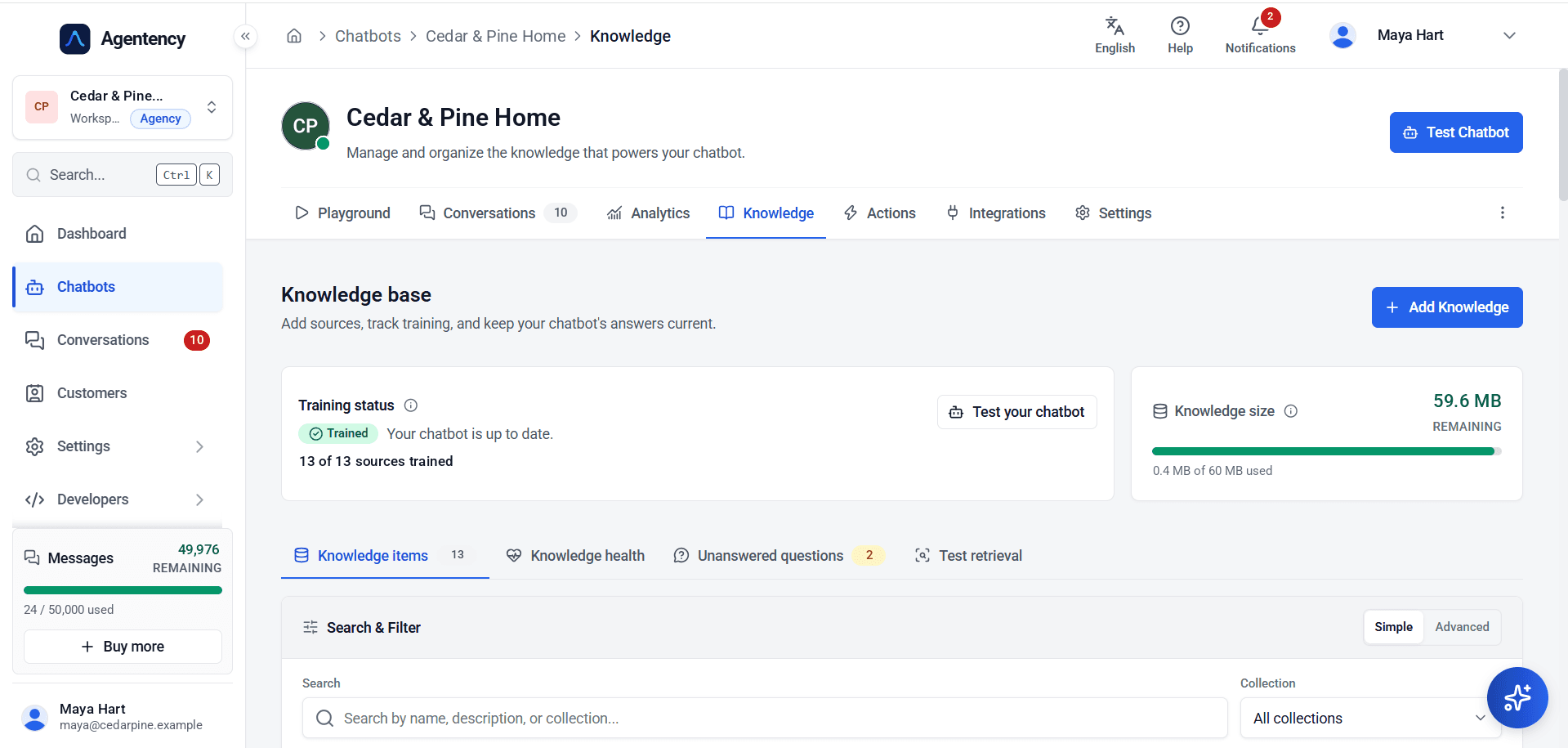
Sample data from a test agent for Cedar & Pine Home, a fictional store.
Each reply can show the passage it used, and in the dashboard you can open any answer to see its sources, confidence score and response time.
Sample conversation
Customer: Does the Harlow sofa come in grey?
Agent: Yes. The Harlow 3-seater sofa comes in three colors: Stone Grey, Oat and Forest Green. Stone Grey is in stock and ships in 5 to 7 working days. Oat and Forest Green are made to order and take 4 to 6 weeks.
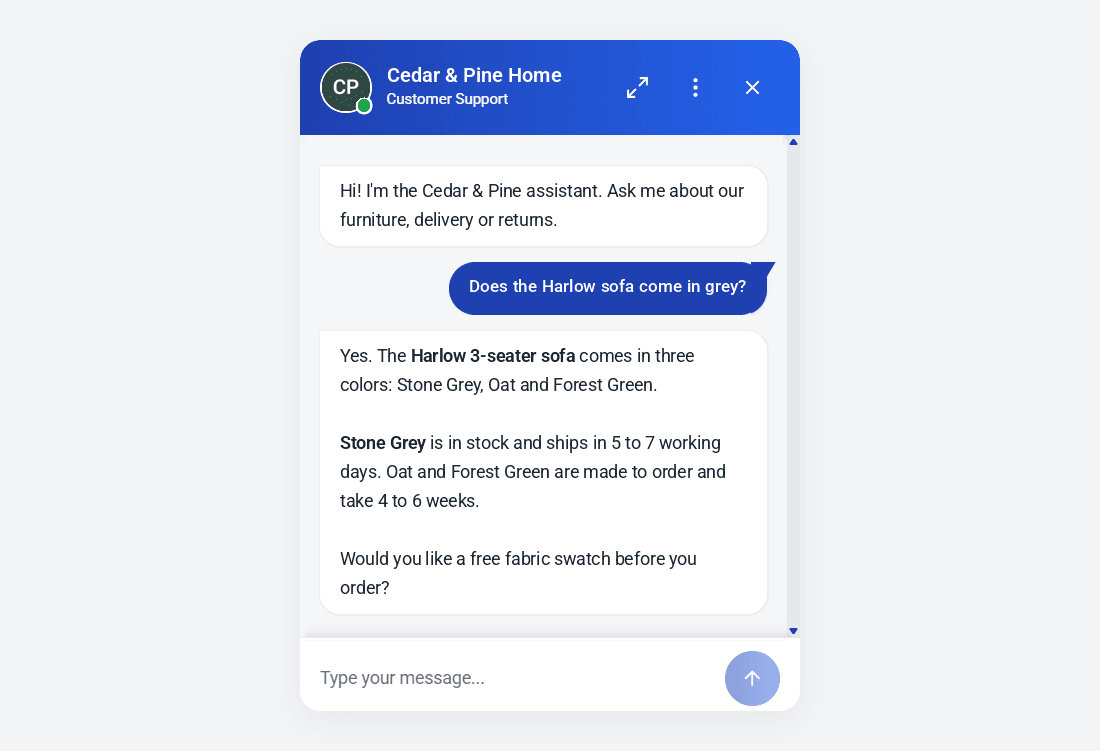
Sample conversation on a test agent.
It stops when it doesn't know
If nothing clears the confidence bar, the agent says so. You set the rule in plain language as a Call Action: when to stop and hand off.
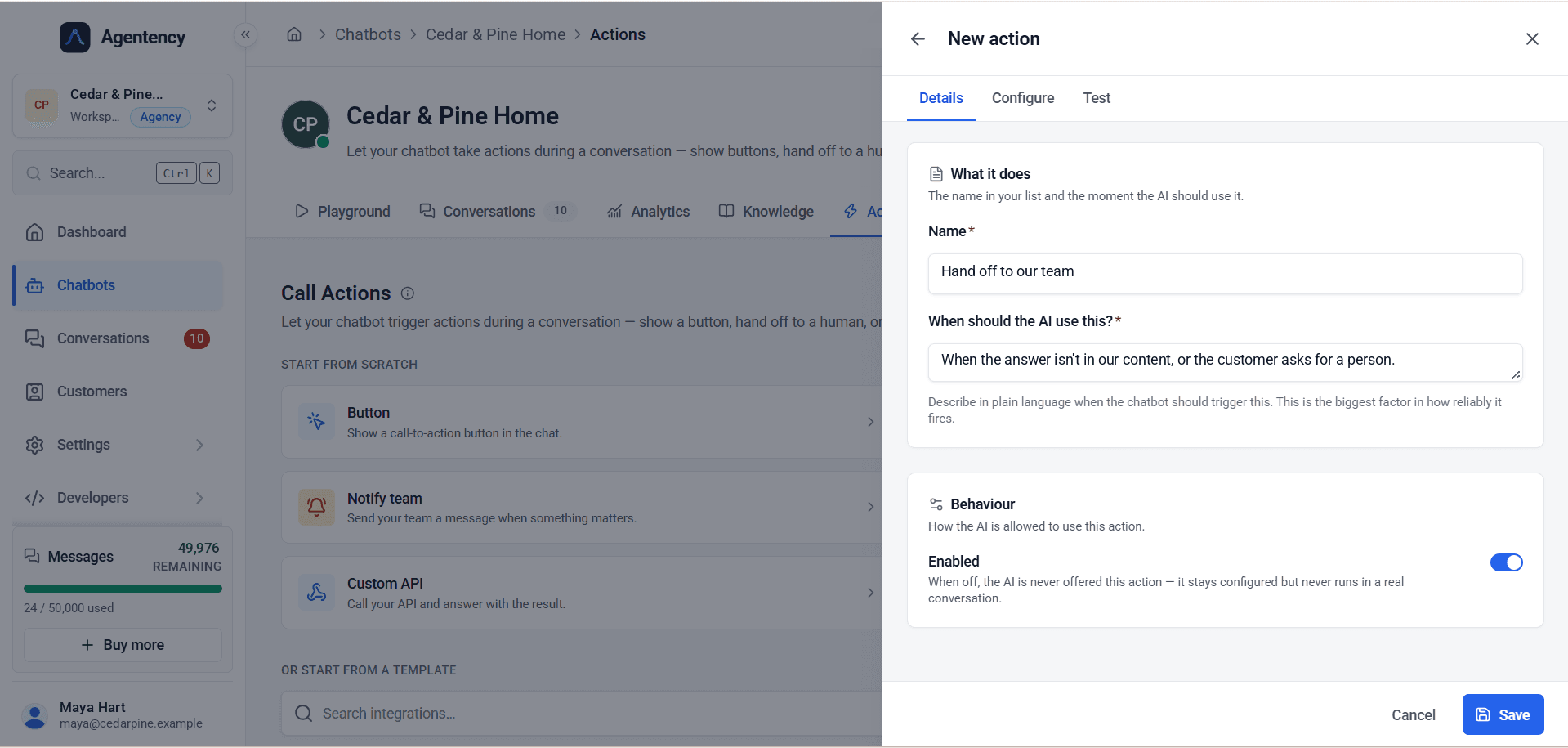
Sample data from a test agent.
Sample conversation
Customer: Do you offer installment payments?
Agent: I don't have information about installment payments, so I won't guess. I've passed your question to the Cedar & Pine team with this conversation, and they'll follow up with you.
Behind the scenes, your team gets an email with the reason and a link to the full transcript. We explain how to design that moment in our guide to chatbot to human handoff.
It works on the channels your customers use
One agent covers your website widget, a shareable chat link and 10 messaging channels: WhatsApp, Instagram, Messenger, Telegram, Slack, Discord, LINE, Viber, WeChat and SMS. It replies in the customer's language.
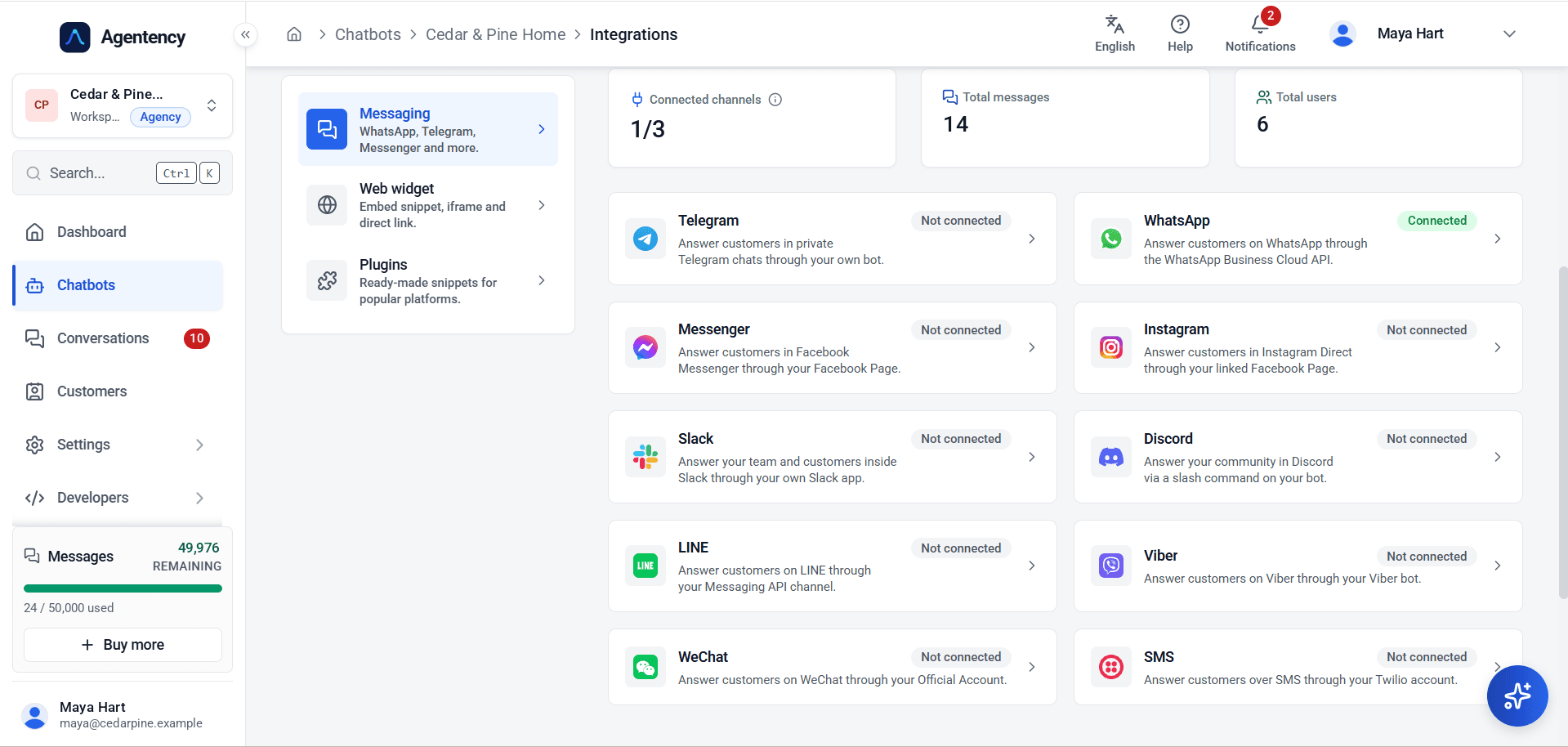
Sample data from a test agent.
It shows you what's working
The dashboard tracks resolution rate, escalation rate, response time and thumbs up or down. The questions it couldn't answer appear in one list, so you can add the missing content in one step.
Who Needs Conversational AI Platforms?
Here are conversational AI examples by team, with the scenario where each one pays off.
Online stores with repeat questions
Delivery times, sizes, stock and returns make up most store chats. If that's your inbox, see how this works for ecommerce stores.
SaaS teams with a help center
If your docs already answer most tickets, an agent trained on them can answer first and send the rest to support with the transcript.
Small teams covering evenings and weekends
Two people can't answer WhatsApp at midnight. An agent can, and it stops when the question needs one of them.
Teams comparing AI agents more broadly
If you need agents that run workflows rather than customer conversations, start with our list of the best AI agents instead.
Back to 11:40 at Night
Remember the grey sofa question?
With the right conversational AI platform, the customer gets the answer in seconds, the installment question goes to your team with the transcript attached, and your phone stays quiet.
You still own every answer. You just don't have to type them at midnight.
Put your own content behind your next late-night question. Start free.
Frequently asked questions
Written by