Benefits of Chatbots in Customer Service, With Data
Search customer service chatbot benefits and you get the same list everywhere. Twenty four seven availability. Reduced costs. Happier customers. All true, all repeated so often across every competitor page that none of it actually tells you anything useful anymore.
Here's the honest version. Which of these benefits you can actually measure, which ones are real but softer than a features page admits, what a chatbot genuinely doesn't fix, and the one habit that decides whether these benefits still exist six months from now or quietly stop being true.
People search this a dozen ways, benefits of chatbot in customer service, ai chatbot customer service benefits, chatbot benefits for customer service, business chatbot customer service benefits, benefits of customer service chatbots, whatever phrasing got you here. Same underlying question, and the honest customer service chatbot benefits don't change based on the wording.
What the Real Benefits Actually Are
An online customer service chatbot earns its keep in exactly two ways. It answers questions your customers already have, instantly, at any hour. And it frees the people on your team from typing the same answer for the tenth time this week. Everything else people list under customer service chatbot benefits is really just a downstream effect of those two things, dressed up differently by whoever's writing the list.
See these benefits measured on your own conversations, not someone else's case study. Start free.
The Customer Service Chatbot Benefits That Are Actually Measurable
Availability, Counted in Actual Hours Back
Twenty four seven availability sounds like a slogan until you count it properly. A support inbox that only gets attention during business hours misses roughly two thirds of the clock, nights, weekends, and the early morning messages that pile up before anyone's logged in. A chatbot handling that window isn't a nice to have, it's literally recovering hours your business was previously giving away for free.
Count your own business hours against a full week to see the real gap. A typical nine to five, five day operation covers roughly forty five hours out of a hundred and sixty eight in a week, which means well over seventy percent of the week was previously unattended by anyone.
Cost Per Contact
Several independent sources converge on a similar range here, and it's worth noting when that actually happens, since a lot of chatbot statistics get repeated without anyone checking whether they still hold up. Chatbot benefits for customer service commonly cited across separate research point to somewhere around a thirty percent reduction in customer support costs in the first year, mostly from handling the repetitive tier one questions that used to eat a support team's day. That's a real, corroborated number, not a single company's marketing claim.
Worth naming directly, since it happens constantly in this space. A different prediction, that agentic AI will resolve the large majority of common service issues autonomously within a few years, gets repeated across nearly every competitor page covering customer service chatbot benefits, often with no scrutiny of what it actually measures or how it was modeled. Repeating a prediction confidently doesn't make it a fact. Treat the thirty percent cost figure and the future prediction as two very different categories of claim, one grounded in current, corroborated data, the other a forecast.
Resolution Rate, Not Just Deflection
This is where a lot of customer service chatbot benefits pages quietly go vague. Deflection means the conversation never reached a human. Resolution means the customer's actual problem got solved. A chatbot can deflect a huge share of conversations while resolving almost none of them, if it's mostly telling people to email support in a friendlier tone. Ask for resolution rate specifically, not deflection, before trusting any number a vendor gives you. We go deeper on exactly this distinction, along with what a customer service chatbot actually is, in our pillar guide on the topic.
Agent Time Actually Freed Up
Business chatbot customer service benefits usually get described as vaguely as "frees up your team." The measurable version is more specific. Count the number of repetitive questions your team answered last month, multiply by the average time per reply, and that's the real number of hours a properly working chatbot gives back. It's rarely small.
Do this exercise honestly rather than optimistically. Pull the actual number from last month, not an estimate of a typical month, since real inboxes are messier and more repetitive than anyone remembers until they actually count.
Run this math against your own support inbox before trusting anyone's average. Start free.
What This Looks Like in Practice
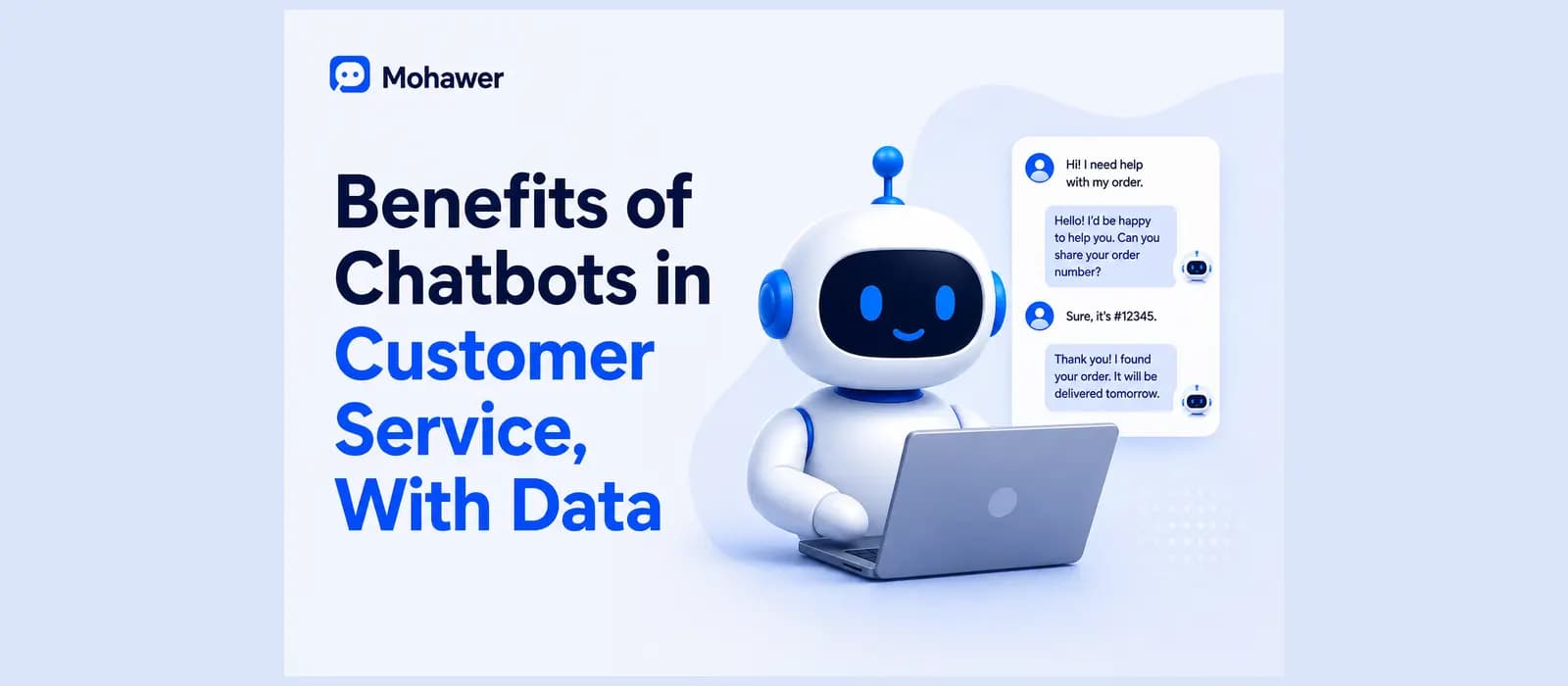
The benefits of chatbot in customer service stop being abstract the moment you look at an actual conversation. A customer messages at midnight asking about a return. The chatbot pulls the real order, confirms it qualifies, and starts the process, all before your team is even awake. That single interaction is every measurable benefit above happening at once, availability, cost savings, and a freed up morning for whoever would have answered that message manually.
For a small ecommerce store specifically, these benefits of chatbot in customer service compound faster than the case studies from large enterprises suggest, since a two person support team feels the relief of five hundred fewer repetitive messages a month far more than a fifty person team does. We go deeper on the ecommerce specific version of this in our AI chatbot for ecommerce guide.
The Customer Service Chatbot Benefits That Are Real But Harder to Measure
Not every genuine customer service chatbot benefit fits neatly into a spreadsheet, and pretending otherwise is its own kind of dishonesty.
Ai chatbot benefits customer service teams actually notice, like consistency across channels, the same tone and accuracy whether a customer reaches you on your website or on WhatsApp, are real and matter to customers, but there's no clean number to attach to them. The same goes for chatbot customer service satisfaction benefits like a customer feeling heard immediately instead of waiting. It shows up eventually in CSAT scores and repeat purchase behavior, but it takes months to see clearly, and any article claiming a precise percentage for "improved brand perception" from week one is making that number up.
Chatbot customer self service benefits fall into this same soft category too, the confidence a customer feels solving something themselves rather than waiting on a reply. Real, genuinely valued by customers who prefer it, and still not something you can put a clean number on after one week of data.
The Honest Tradeoffs
A chatbot has real limits, and the advantages of chatbots don't cancel out the disadvantages just because a vendor wants to sell you one.
It handles repetitive, predictable questions well. It handles a genuinely upset customer, a complicated edge case, or anything requiring real judgment poorly, and pretending otherwise produces exactly the frustrating experience that turns someone off automation entirely.
The mistake most businesses make isn't choosing to use a chatbot. It's assuming the disadvantages disappear once the chatbot is live, and then being surprised months later when a customer complains about being stuck talking to a bot that couldn't help them. That complaint is usually less about the chatbot existing and more about a handoff that didn't happen when it should have. Chatbot customer self service benefits are real for the customer who wants a fast answer to a simple question. They're not a substitute for a person when the situation actually calls for one. The honest answer to advantages and disadvantages of chatbot is that both are true at the same time, and a chatbot that hands off cleanly the moment it hits its limit captures the benefits without pretending the limits don't exist. If you're still comparing tools and want the honest version of which ones handle that handoff well, our comparison of the best ai chatbots for customer service covers that directly rather than just listing features.
The Habit That Actually Makes the Benefits Last
Here's what almost every competitor page gets wrong, including some of the more established ones covering benefits of chatbot services in customer service. They describe the AI as learning automatically, as if the benefits above just keep compounding on their own once you turn the thing on.
It's an appealing story. A chatbot that gets smarter forever without anyone doing anything sounds like the whole point of automation. It's also not how any of this actually works, and saying so plainly is worth more than repeating the appealing version.
They don't. A chatbot that nobody reviews after launch stops improving right there, permanently, while the business quietly assumes it's still getting smarter. It isn't. The actual habit that keeps these benefits real is simple and unglamorous. Someone looks at what the chatbot couldn't answer, every week, and adds that missing piece to what it knows. Five minutes, once a week. Skip this for a month and the same benefits everyone lists start quietly eroding, not because the chatbot got worse, but because your business changed and nobody told it. This exact pattern shows up across the real, concrete scenarios we've catalogued in our breakdown of customer service chatbot use cases, worth reading if you want the specific, named examples rather than the general principle.
See the habit that keeps these benefits real, built directly into the product. Start free.
How Agentency Tackles This
Everything above is true of the category generally. Here's specifically what we built, since this is the part I can actually speak to firsthand.
Resolution Rate, Not Deflection, on the Dashboard
The account dashboard tracks actual resolution rate alongside average response time and handoff rate, with real trend charts over 7, 30, and 90 day windows, not a single vague headline percentage with nothing behind it.
The Needs Attention Panel Is the Weekly Habit, Built In
Every question the agent couldn't answer shows up in one place, so the weekly review this whole article has been describing takes five minutes instead of requiring anyone to dig through raw chat transcripts. This is the actual mechanism behind chatbot customer service satisfaction benefits holding up past month one instead of quietly fading.
The Same Consistency on WhatsApp as Your Website
Deploy the identical agent to your website widget and ten messaging channels including WhatsApp, so the ai chatbot customer service benefits customers get on your site are exactly what they get wherever else they reach you, not a stripped down version bolted on afterward.
Human Handoff With the Full Story Attached
When a conversation needs real judgment, the agent flags it and hands your team the entire history, so the honest tradeoff covered above, knowing when to step back, is built in rather than left to chance.
Pricing That Doesn't Punish You for Success
There's a free forever plan, one agent, fifty messages a month, enough to measure these benefits against your own content before paying anything. Full pricing details are worth checking directly, since every tier includes a spend ceiling so measuring these benefits never turns into a surprise bill.
Frequently asked questions
What are the benefits of AI in customer service?
Mainly instant answers outside business hours, lower cost per contact from handling repetitive questions, and freeing your team's time for conversations that actually need a person. The honest, sourced version of each is covered in the sections above.
What are the benefits of using a chat AI bot?
Speed and availability for the customer, and reduced repetitive workload for your team, provided someone keeps reviewing what it couldn't answer so those benefits don't quietly fade after launch.
How can chatbots help reduce customer service costs?
Mainly by absorbing the high volume, low complexity questions, order status, password resets, basic policy questions, that otherwise eat a disproportionate share of a support team's time. Multiple independent sources converge on roughly a thirty percent reduction in the first year for businesses that do this well.
What are the advantages and disadvantages of a chatbot?
The advantage is instant, consistent answers to predictable questions at any hour. The disadvantage is that it handles genuine complexity, real frustration, or anything needing judgment poorly. A good setup captures the advantage and hands off cleanly the moment it hits the disadvantage, rather than pretending the second one doesn't exist.
Do chatbot benefits apply to a small business, not just large companies?
Yes, and often more so. A small team has less spare capacity to absorb repetitive questions manually, which means the hours a chatbot gives back matter proportionally more than they do for an enterprise with a large existing support staff.