AI Chatbot for Ecommerce Stores: The Small Business Guide
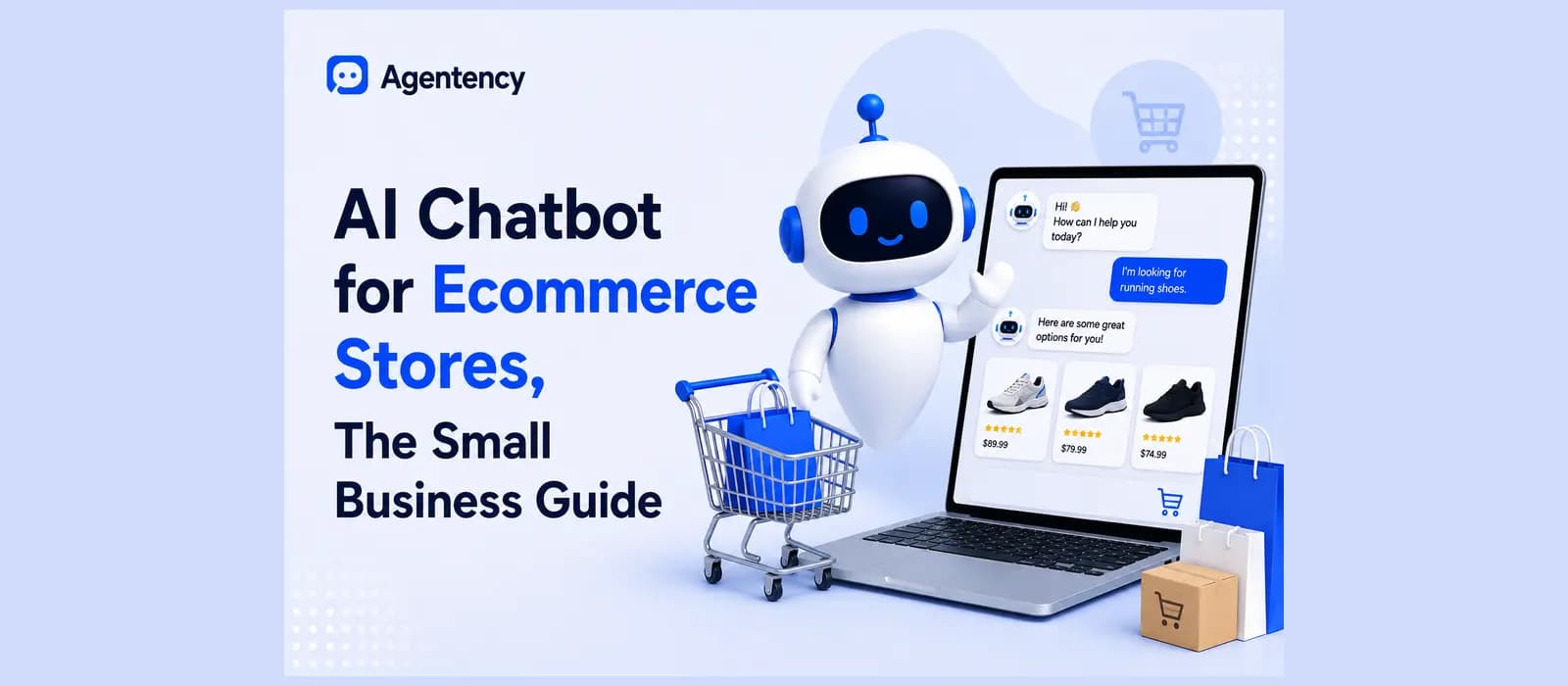
You're packing an order at the kitchen table when a WhatsApp message comes in asking where a different order is. You answer it, go back to packing, and ten minutes later the same question shows up from someone else. That's not a hypothetical, it's a normal Tuesday for a lot of store owners, and it's the actual reason an AI chatbot for ecommerce store gets used in real life, not the peak season staffing scenarios every other guide on this topic leads with.
The Real Question at Thirty Orders a Day
What Actually Matters at Your Scale
What is the best AI chatbot for ecommerce stores depends entirely on how many orders you're actually running, and almost nobody writing about this admits that plainly. An enterprise deployment cares about peak season scaling, multi department routing, and integration with a support team of twenty people. An AI chatbot for ecommerce store use at your scale cares about one thing. Does it answer the same five questions your customers ask every single day, without you having to be the one typing the reply.
The honest test is simple. Open your own inbox right now and count how many messages this week were some version of where's my order, does this come in my size, or what's your return policy. That number, not a case study from a company with a call center, is what tells you whether a chatbot is worth setting up. This applies whether you're currently handling it through ecommerce live chat, email, or just your personal WhatsApp, the volume itself is what matters, not which tool you're using to answer it today.
Where This Guide Actually Applies
Here's what genuinely changes as your order count grows, since it isn't a straight line. At five orders a day, you can probably answer everything yourself and a chatbot is premature. At thirty, the repetitive questions start eating real time you'd rather spend on the parts of running a store that actually need you. At three hundred, you've crossed into territory where most of the enterprise advice in this space finally starts applying. This guide lives in that middle zone, thirty to maybe two hundred orders a day, which is where most small stores actually operate and where almost nothing useful gets written. People search this a dozen ways, best AI chatbot for ecommerce for small business, best AI chatbot for ecommerce small business, AI chatbot for ecommerce stores 2025, whatever phrasing got you here, and the honest answer stays the same regardless of the wording.
See what an AI chatbot for ecommerce store setup actually looks like on your own products. Start free.
What This Actually Costs at Small Store Volume
The Honest Price Range
Every competitor covering AI chatbot for ecommerce stores quotes enterprise numbers. Consumption based pricing with volume discounts. Custom quotes starting around thirty thousand dollars a year. Annual contracts scaling into six figures for high volume deployments. None of that has anything to do with what you're actually going to pay.
The honest range at real small store volume. Free to start on a genuinely usable free tier, enough to test the whole idea against your own products before spending anything. Somewhere between nineteen and a hundred dollars a month once you're past that, depending on how many conversations you're actually running. A custom build from a developer runs into the thousands and is something almost no store at this scale genuinely needs, no matter how convincing the sales page sounds.
Watch the Pricing Model, Not Just the Sticker Price
Some platforms charge per conversation or per resolution, which sounds fine until your best month, the one where you finally get real traffic, turns into your most expensive month too. A flat monthly tier with a message cap is easier to budget against, since a good week doesn't quietly become a bad bill.
If you're specifically weighing AI chatbot cost against just hiring seasonal help, run the actual math against your real numbers, not a rough guess. Pull last month's total customer messages across every channel you use, and compare that number against what a part time hire would actually cost you for the same hours. The chatbot math usually wins at this scale, but it's worth checking rather than assuming.
The Real Math on Hours Saved
A rough worked example, using numbers a small store might actually see. Three hundred customer messages a month, at roughly two minutes of someone's time per message to answer manually, is ten hours of work every month just on repetitive questions. At even a modest hourly rate, that's real money, and it's money spent on questions a chatbot answers instantly at any hour, not just during whatever hours you happen to be awake and checking messages. That's really the whole case for AI chatbot benefits at this scale, stated plainly instead of dressed up in a features list. Hours back, answered instantly, at a cost that's usually lower than what those hours were quietly costing you already.
Which Task to Automate First
Order Status First
Best AI chatbot for ecommerce for small business searches usually come from someone who's decided to do this but hasn't decided where to start. Order status is the single most repetitive question at any store, any size, and it's also the easiest to get right since the answer lives directly in your order data. There's no judgment call involved, no policy interpretation, just a lookup and an honest answer, which makes it the safest place to start trusting a chatbot with real customer conversations.
Returns and Sizing Second
Once order status is handled well, this is usually the next biggest chunk of repetitive volume, and it's where a chatbot connected to your real policy prevents the vague, inconsistent answers that turn into actual returns. A customer who gets a clear, consistent sizing answer before buying is a return that never happens, which matters more to a small store's margins than it does to a business with enough scale to absorb returns as a cost of doing business.
Product Questions Third
Stock checks, material questions, anything that requires the chatbot to actually know your catalog rather than just your order system. This one takes slightly more setup, which is exactly why it comes third, not first, since it's the one place a chatbot that hasn't been trained properly on your actual products is most likely to guess instead of admit it doesn't know.
Why the Sequence Matters More at Your Scale
Don't try to cover all three on day one. A best AI chatbot for ecommerce stores setup that tries to do everything at once usually ends up mediocre at all three instead of genuinely good at the one that matters most this week. A large support team can afford to have a chatbot launch imperfectly across five categories at once, since human agents are right there to catch whatever it misses. You don't have that safety net, which makes getting one thing genuinely right before moving to the next a real necessity, not just a nice to have best practice from a slide deck.
Set up the first task on this list against your own store today. Start free.
What Every Other Guide on This Topic Assumes You Already Have
The Enterprise Assumptions Baked Into Most Advice
Read enough of these guides and a pattern shows up fast. They assume you have a support team to free up, not a team of one. They talk about peak season panic hiring, as if hiring is even on the table for a business your size. They quote enterprise integration lists, Salesforce, ServiceNow, a dedicated CRM, none of which a store doing thirty orders a day has any reason to touch yet.
None of this makes those guides wrong, it makes them written for someone else, the same way a guide to running a restaurant chain isn't wrong for assuming you have a head chef, it's just not written for the person cooking everything themselves three nights a week.
The Questions Worth Asking Instead
Can you set this up yourself, this afternoon, without a developer. Does the free tier let you genuinely test it, not just glance at a demo. Does the pricing model punish you the moment your store actually starts doing well. If a guide never addresses any of these, it wasn't written with your business in mind. For the fuller, general version of what an AI chatbot for ecommerce actually is and how it works, our complete guide covers that ground without assuming any particular store size.
If You're on Salla or Zid, Not Just Shopify
The Platform Gap Nobody Addresses
Almost every AI chatbot for ecommerce stores comparison defaults to Shopify, WooCommerce, and BigCommerce as if those were the only platforms that exist. If your store runs on Salla or Zid, which a huge number of merchants across the Middle East and North Africa actually do, that gap matters more than it should.
A chatbot that only reads Shopify data is only doing half its job for a merchant running a completely different platform. Before committing to anything, confirm directly whether native Salla and Zid integration actually exists, not just a generic claim of ecommerce support that turns out to mean Shopify and nothing else once you dig in. If Shopify specifically is your platform, we've covered the setup and best picks in more depth in our AI chatbot for Shopify guide. The same honesty about what chatbots for retail actually need applies whether you're running Shopify, Salla, or Zid, the platform changes the integration, not the underlying logic of what to automate first.
The One Question to Ask Before You Commit
Can the chatbot actually pull a real order number and status from your Salla or Zid dashboard, the same way it would from Shopify, or does supporting your platform just mean the widget loads on your site while the actual order lookup silently doesn't work. That gap between claiming to support a platform and actually reading real data from it is exactly where a lot of small MENA based merchants get a half finished product without realizing it until weeks into using it.
How Agentency Handles AI chatbot for Ecommerce Stores
Built for a Team of One as Much as a Team of Twenty
There's no enterprise sales call required to get started, no minimum contract, no consumption pricing that punishes you for a good month. A guided setup gets an AI chatbot for ecommerce store running from a template gallery in an afternoon, not a quarter. If you want the deeper breakdown of what to actually look for in a no-code platform before committing to any one of them, our no-code chatbot builder guide covers that decision in full.
This isn't a smaller, stripped down version of an enterprise product either. It's the same underlying platform, the same retrieval engineering, the same anti hallucination checks, just without the enterprise sales process and the enterprise price tag bolted on top. A store doing thirty orders a day gets the same actual product as one doing three thousand, priced for the volume it's actually running.
Native Salla and Zid, Not Just Shopify
The agent connects natively to Salla and Zid alongside Shopify and WooCommerce, so a MENA based merchant gets the same real order lookups and product accuracy that a Shopify only tool only offers its own customers.
Order Status, Returns, and Product Questions, in That Order
Through roughly 31 ready made integration templates, the agent can look up a real order, check stock, and answer from your actual return policy, matching the exact three task sequence covered above rather than a generic feature list that doesn't match how a small store's inbox actually fills up.
The Same Agent on WhatsApp, Not Just a Website Widget
Deploy the identical agent to WhatsApp and nine other messaging channels alongside your website widget, since a huge share of small store customer service in this region happens on WhatsApp specifically, not a website chat bubble.
A Free Plan That Actually Lets You Test This
There's a free forever plan, one agent, fifty messages a month, enough to genuinely test order status, returns, or product questions against your own real content before paying anything. Full pricing details are worth checking directly, and every paid tier includes a spend ceiling, so a genuinely good week never turns into a surprise invoice. Fifty messages a month sounds small until you realize that's exactly enough to properly test the one task you're starting with, order status specifically, against a real week of your own customer messages.
The Needs Attention Panel Replaces a Full Support Team's Review Process
Every question the agent couldn't answer shows up in one place in the dashboard. For a team of one, this is what a whole quality review process would look like at a bigger company, just built directly into the product instead of requiring headcount you don't have. We've written more on this exact habit, and on evaluating a customer service chatbot honestly beyond just ecommerce, in our pillar guide on the topic.
Try the exact task sequence above on your own store this week. Start free.
Key Takeaways
- Order volume, not company size, is what should decide whether you need a chatbot yet, and thirty orders a day is roughly where the math starts making sense.
- The honest cost at this scale is nineteen to a hundred dollars a month, not the thirty thousand dollar enterprise quotes every competitor guide leads with.
- Automate order status first, returns and sizing second, product questions third, in that order, since a team of one doesn't have the safety net a bigger support team has if a chatbot launches imperfectly across everything at once.
- If your store runs on Salla or Zid, confirm the chatbot actually reads real order data from those platforms specifically, not just Shopify with everything else bolted on as an afterthought.
Frequently asked questions
What is the best AI chatbot for ecommerce stores?
There isn't one universal answer, and it depends heavily on your actual order volume. For a store doing thirty to fifty orders a day, the right answer is usually a no-code platform with a genuine free tier and flat pricing, not an enterprise tool built for support teams and six figure contracts.
Is there a best AI chatbot for ecommerce for small business specifically, and how does it differ from a best AI chatbot for ecommerce small business search?
Both phrasings mean the same thing. Look for platforms with a real free tier, no minimum contract, and native integration with whichever platform you actually run, including Salla and Zid if that's your store, not just Shopify. Test the free tier directly against your own products before committing to anything paid.
What is an AI chatbot for ecommerce store actually good for at small volume?
Order status, returns, sizing questions, and basic product questions cover the large majority of what a small store's customer messages actually are. Start with order status specifically, since it's the highest volume and easiest to get right.
How much does an AI chatbot for ecommerce stores 2025 setup actually cost now?
Free to start on a genuine free tier, then roughly nineteen to a hundred dollars a month at real small store volume once you're past that. Enterprise quotes in the tens of thousands are for a completely different scale of business.
Do I need a developer to set up an AI chatbot for ecommerce store?
No, not with a proper no-code platform. Most setups at this scale take an afternoon, connecting a channel and uploading your existing product and policy content, without writing a line of code.
How is this different from the general AI chatbot for ecommerce guides out there?
Most guides on this topic assume enterprise scale, a support team, and integration needs a small store doesn't have yet. This one is written specifically for the store still answering its own messages, with the actual cost, task sequence, and platform considerations that matter at that size.
Should I wait until my store grows before setting up a chatbot?
Not necessarily. If you're already spending real time on repetitive questions, that time is worth recovering now, not once you've grown enough to justify hiring someone to answer them instead. A free tier lets you test this without any real financial commitment either way.